Revisiting David Hockney’s House on the West Coast With a One-of-a-Kind Painted Swimming Pool
David Hockney, the British artist most famous for his 1960s paintings of Los Angeles swimming pools and double portraits rendered in vivid acrylic paints, died at his London home on Thursday, June 11, at age 88. The contemporary icon had a prolific, seven-decade-long career in which he explored a range of media, including photography, landscape paintings, printmaking, stage design, collage, and—later in life—digital drawings created on his iPad.
The artist was born on July 9, 1937, in Bradford, England, where he attended Bradford School of Art. From 1959 until 1962, he studied at London’s Royal College of Art. Even before graduation, he began selling his art professionally, under the wing of art dealer John Kasmin. “The moment I first sold pictures to earn a living, I felt rich. I’ve been rich ever since,” Hockney said in a 1995 interview with The Associated Press. “I didn’t have much money, but I did what I wanted. ... You are a rich man if you do the things you want to do.” In 2018, Hockney’s 1972 painting Portrait of an Artist (Pool with Two Figures) sold for a record-breaking $90.3 million—at the time, the most expensive work by a living artist ever sold.
Hockney remained active in his career until the end. “What an artist is trying to do for people is bring them closer to something,” he told AD in 2020. “I am constantly preoccupied with how to remove distance so that we can all come closer together, so that we can all begin to sense we are the same, we are one.”
Below, we’re revisiting our tour of Hockney’s colorful home from the April 1983 issue of AD. Here, he took design inspiration from Parade, a ballet and opera triple bill for which he designed the sets and costumes that hit the stage at the Metropolitan Opera House in 1980. —Katie Schultz
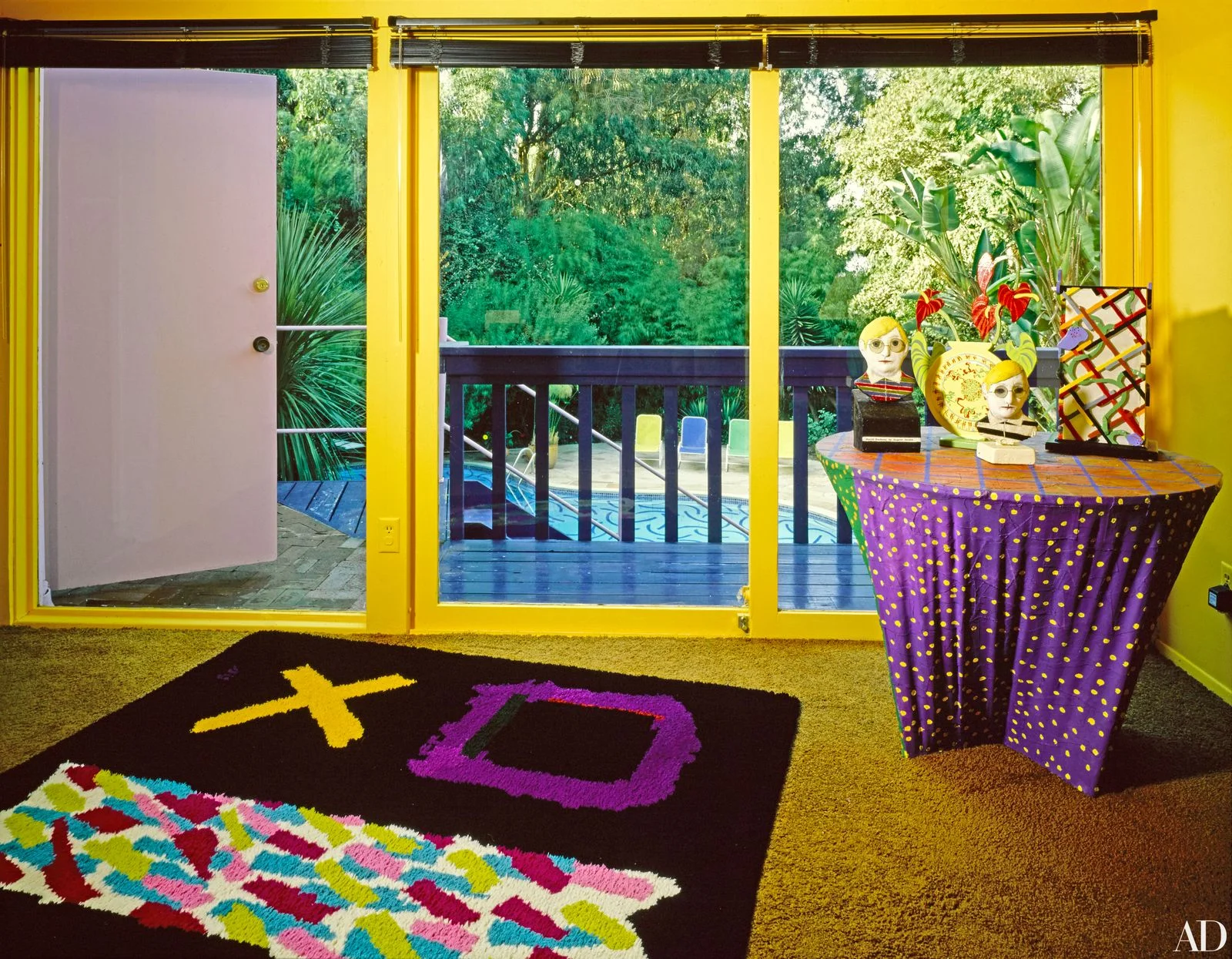
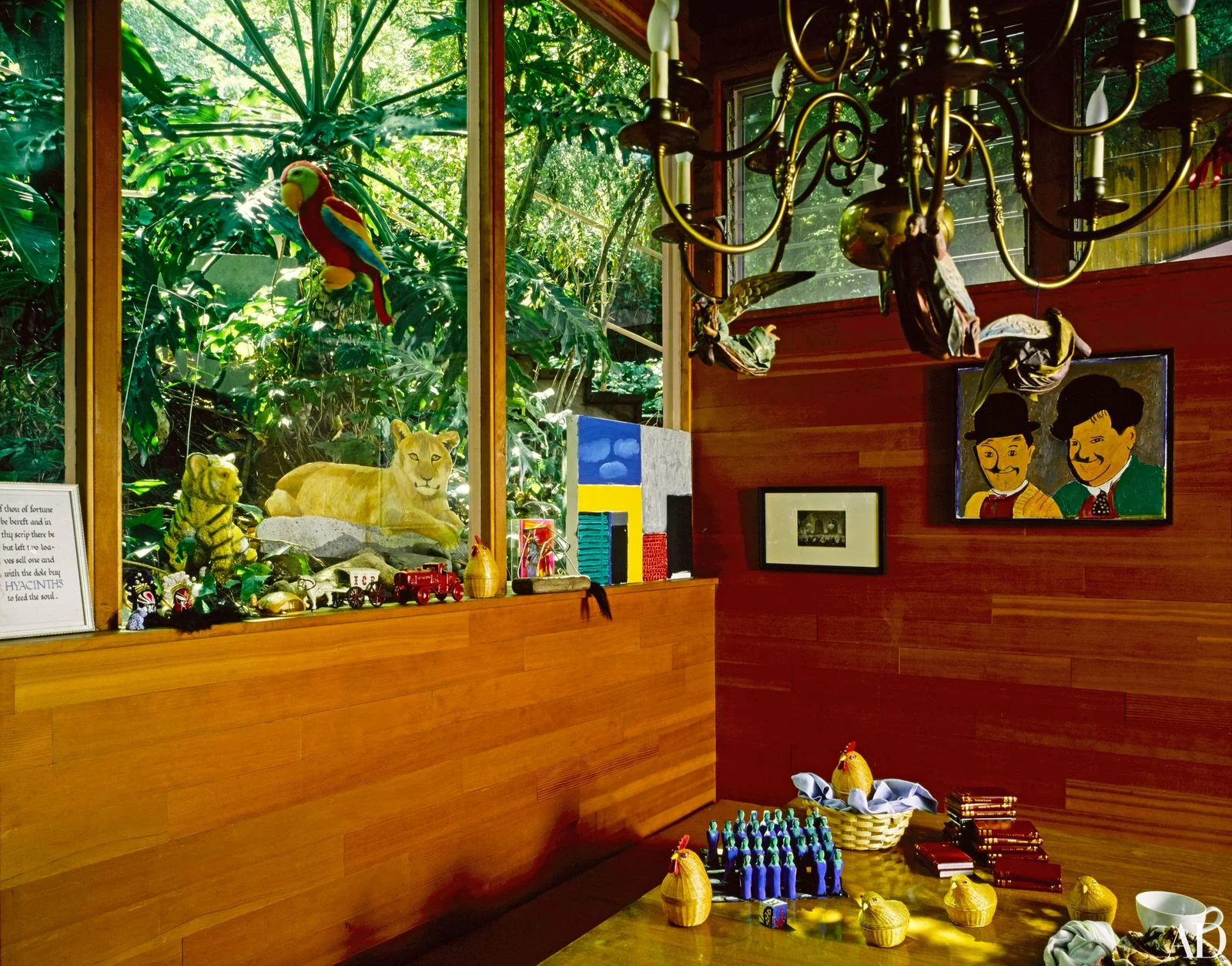
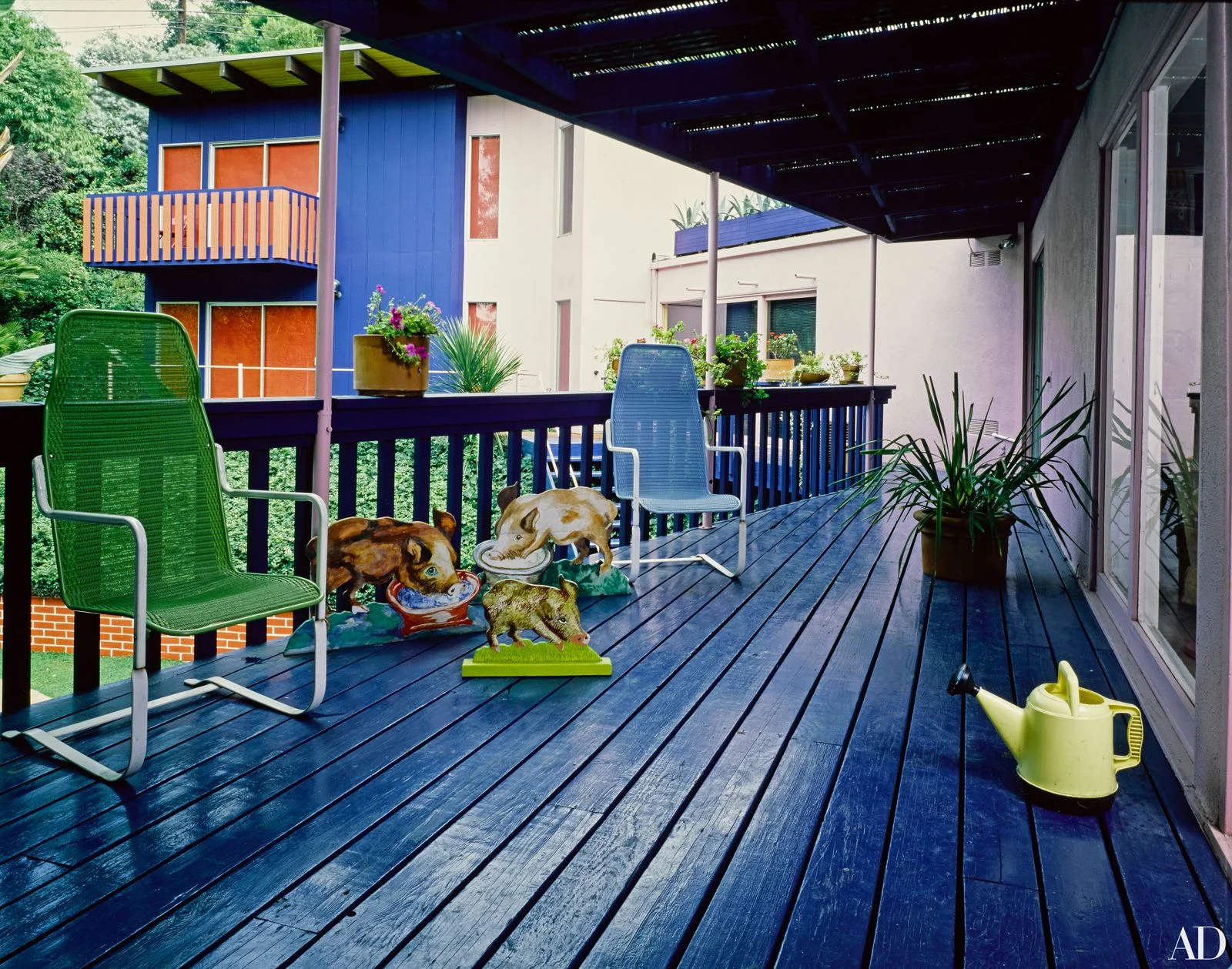
Like the artist, David Hockney’s house is an original. In its audaciousness, it seems to fly in the face of conventional taste, but he reflects happily, “Everyone who comes here likes it. People don’t dare such colors usually.” Hockney began creating his unique “set” for living three years ago when he purchased, on the West Coast, a somewhat ordinary brown ranch-style house nestled against a wooded hillside. The transformation has taken place gradually as he has devised the exotic palette for each architectural element, each room, one step at a time. The only structural change has been the addition of three pyramid-like apertures to light the studio/living room. “What I am doing, slowly, is making my own environment—room by room—as artists do. Of course it’s fun,” he says.
An obsession with sets and settings has occupied the artist for several years—a period that has seen the creation by him of two new productions for the Metropolitan Opera and a revival of The Rake’s Progress in San Francisco. Hockney’s designs for the French triple bill Parade and for an evening in honor of Stravinsky’s 100th anniversary are considered by many to be among the Met’s most stunning achievements. Therefore it should be no surprise to find that the artist’s favorite portion of these productions has inspired his evolving personal environment.
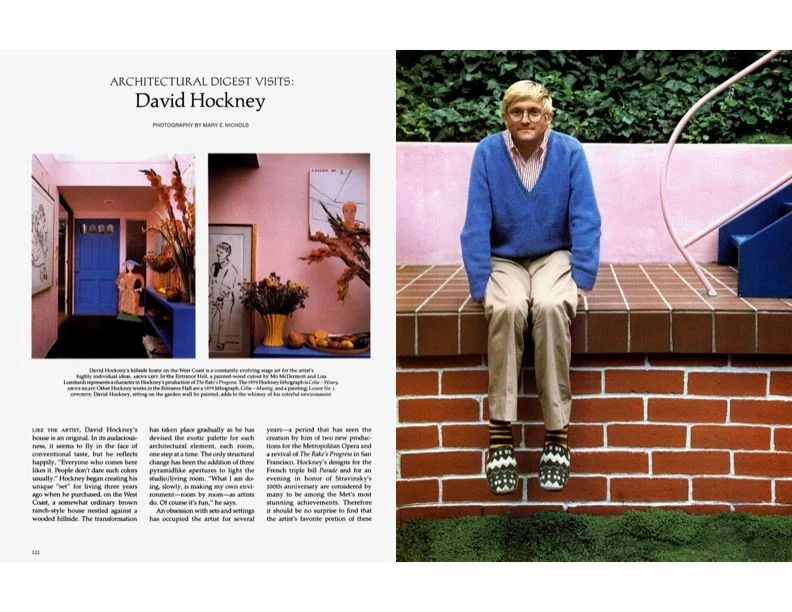
“The colors of the house,” he explains, “are from Parade—in particular, from Maurice Ravel’s L’Enfant et les sortilèges, the most beautiful musical story ever written, and the most colorful of all the operas.” Parade is composed of Erik Satie’s short ballet of the same name, originally designed by Picasso for Diaghilev, in 1917, and two one-act operas—Francis Poulenc’s Les Mamelles de Piresias, and the Ravel work.
In discussing the artist’s designs for the theater, art historian Marco Livingstone has observed, “Hockney thinks of his sets as large pictures, but as three-dimensional, rather than two-dimensional pictures.” Thus it becomes clear that the artist also thinks of this particular set—his house—as a large three-dimensional picture in progress. It has changed dramatically in the past few months, and he bemoans the fact that there is no record of these changes. Other changes are inevitable. “Perhaps then I will make my own photographs.”
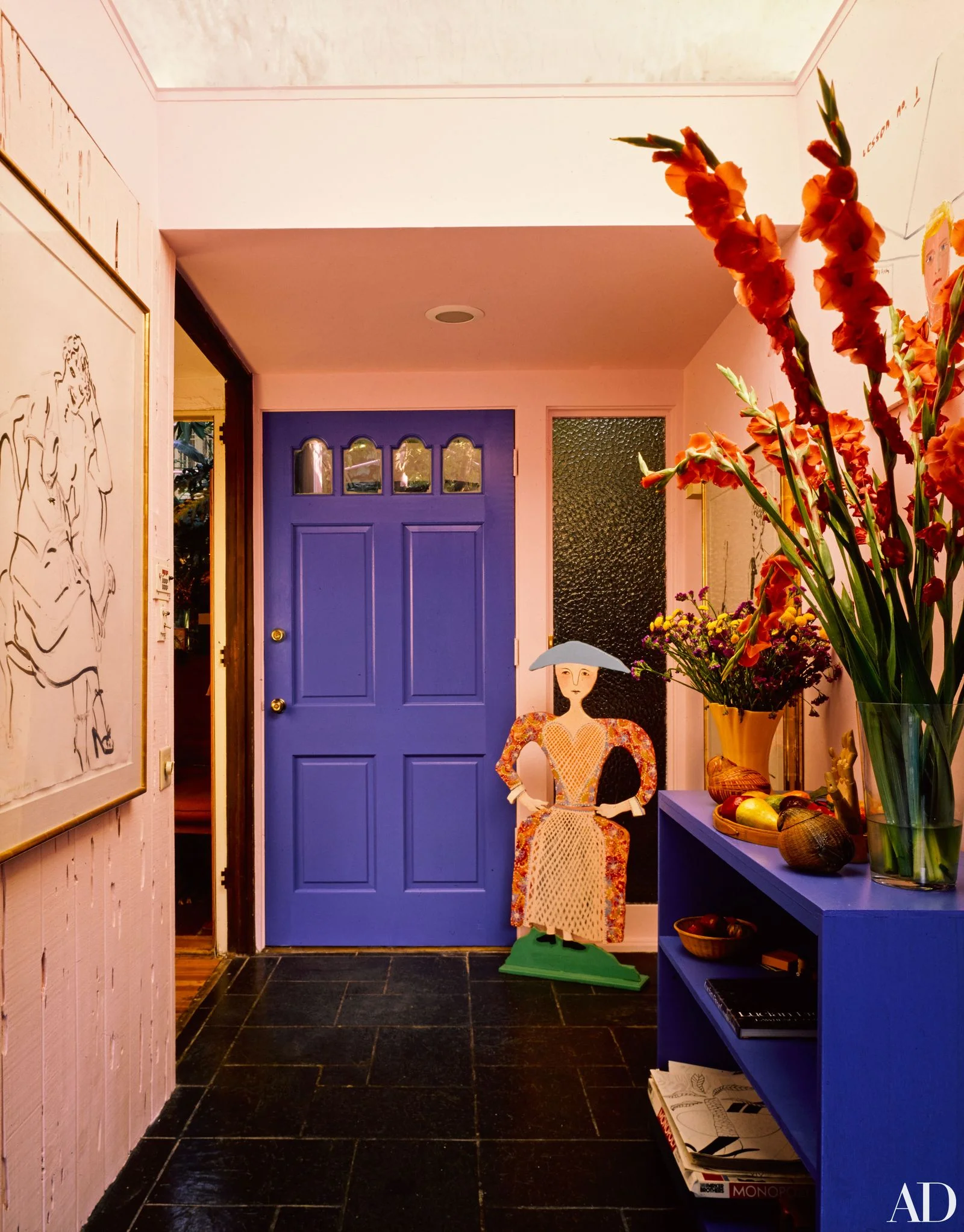
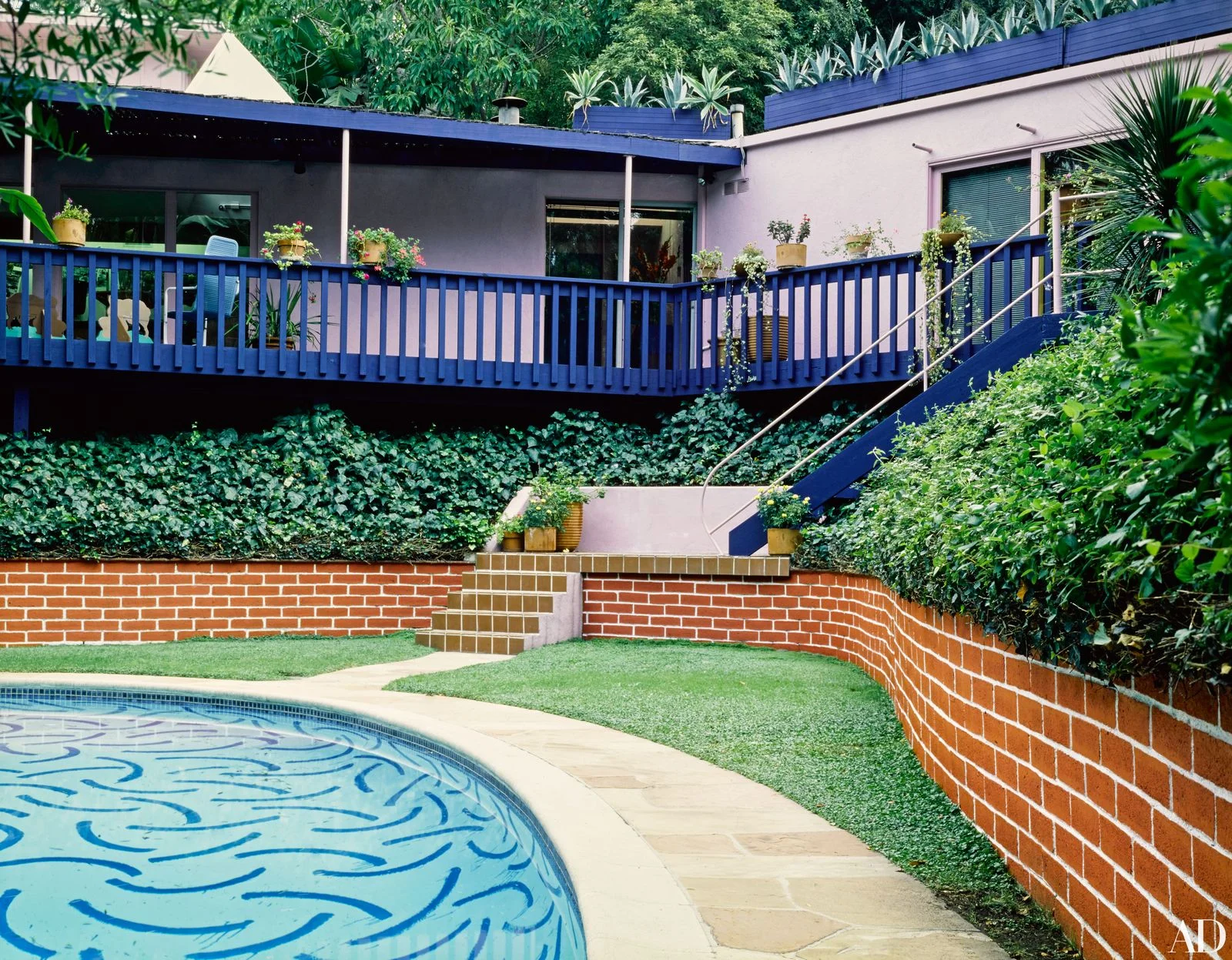
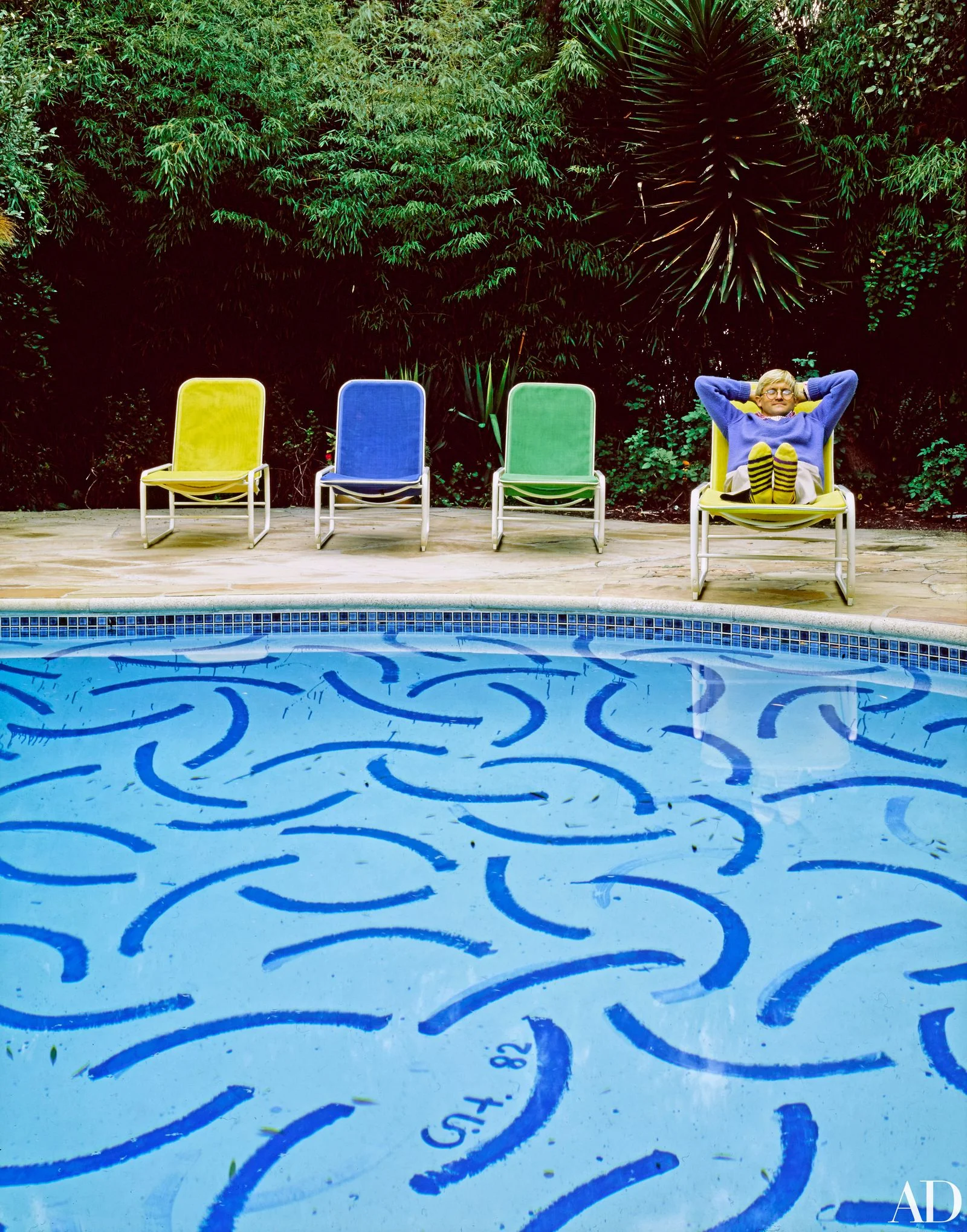
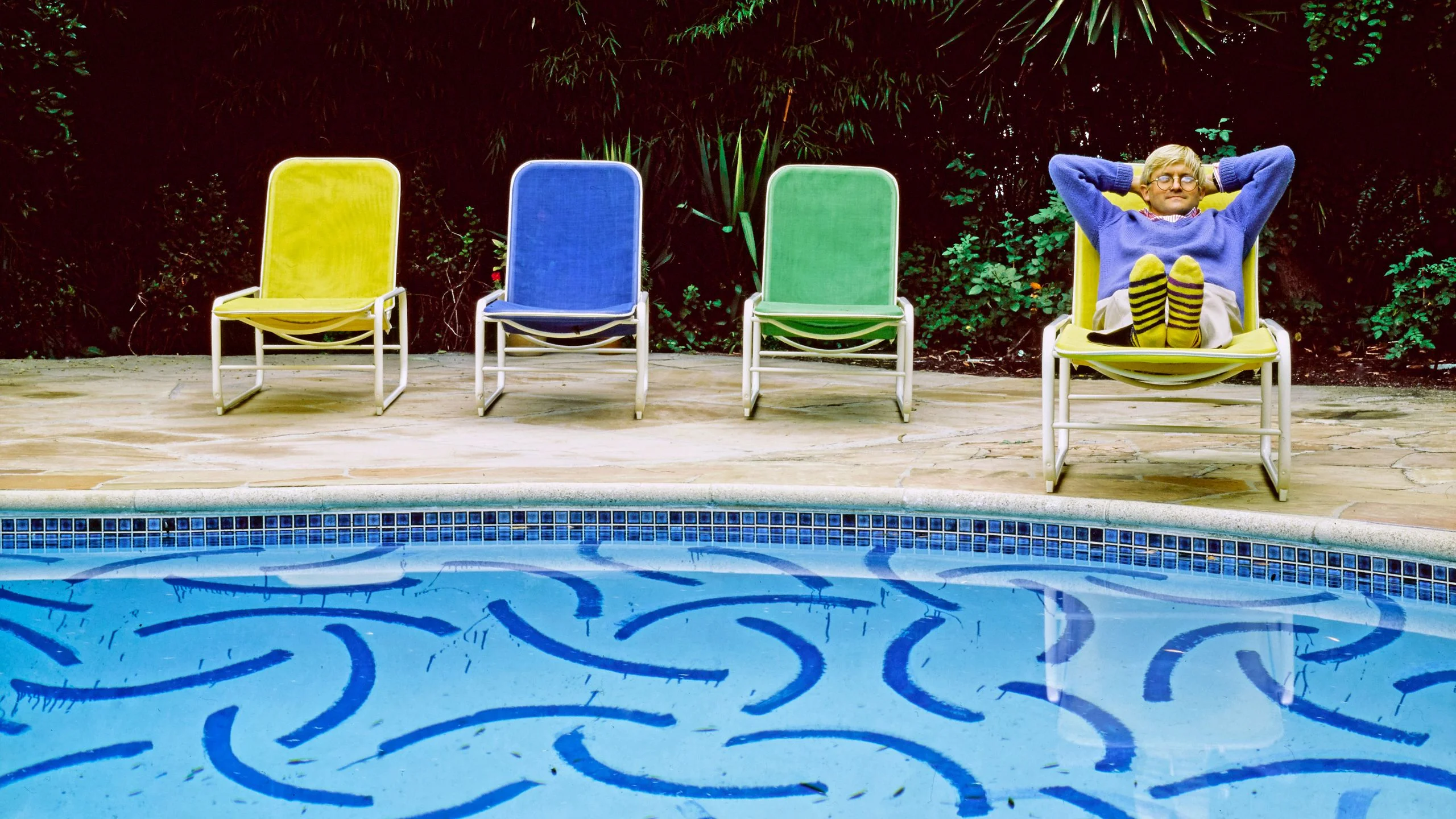
Though Parade has provided the dominant theme for the house, echoes of other Hockney works of art, and of his ongoing aesthetic concerns, are everywhere. The pool, painted by the artist himself with the very French “Dufy-esque” marks he learned to love in Paris, is a motif that abounds in his work. Sun-dappled California swimming pools—culminating in a series of handmade, essed-color paper-pulp pictures—began to appear in his work soon after his first visit to the West Coast.
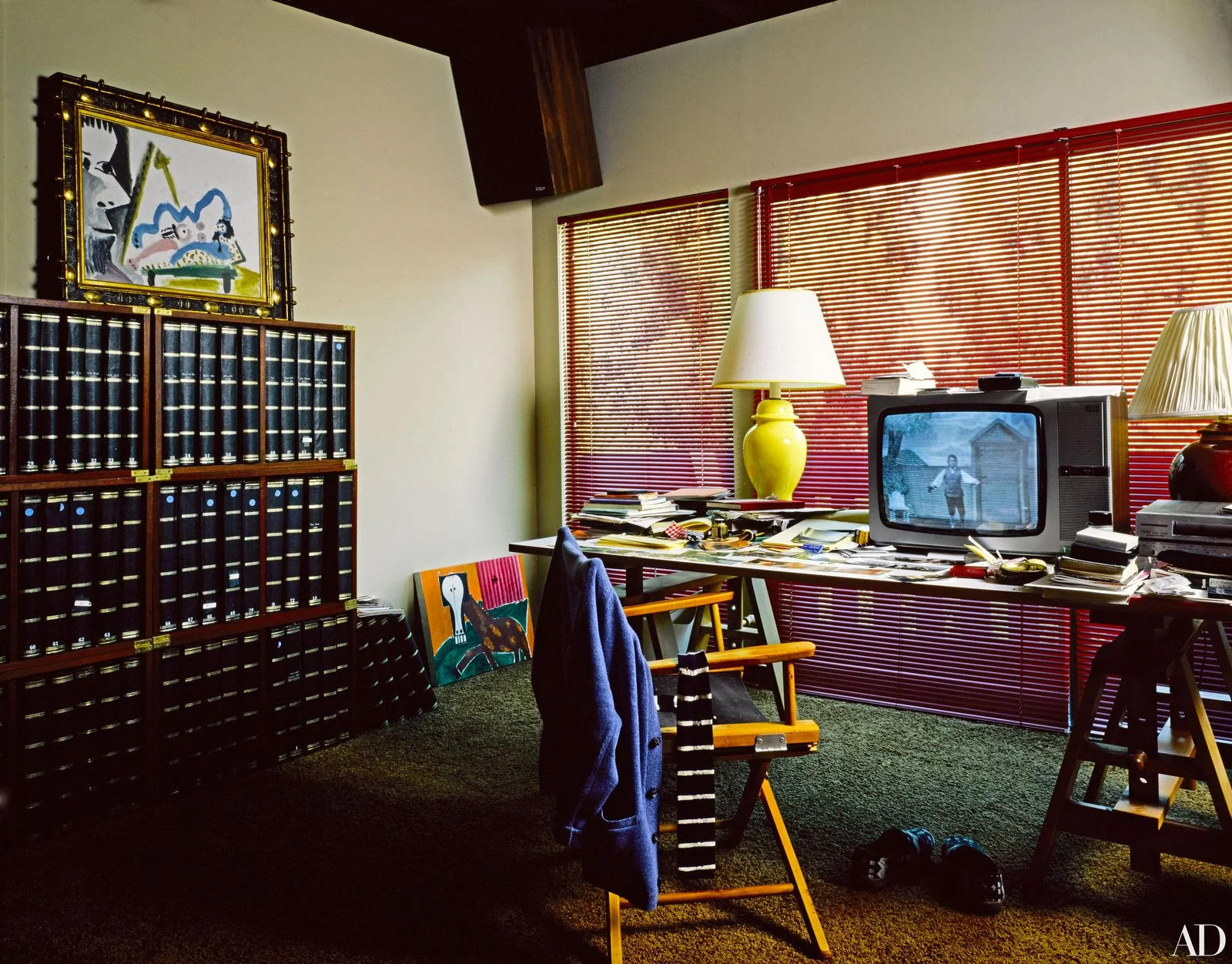
Another visible clue to the sources of his inspiration is the 1965 Picasso painting Artist and Model, which occupies a prominent place in David Hockney’s bedroom—a constant reminder of Picasso’s role as the imaginary mentor. In etchings made a decade ago, Hockney depicted himself as the master’s supplicant model and student, and to this day, his conversation, his art, and his house are punctuated with references to the giant of modernism. “The Picasso is my only picture. Normally the pictures I want are not available. If they would just lend me a Piero della Francesca, a Rembrandt, a Velázquez, for a little while, it would be lovely. If you’re an artist, you’re not obsessed with objects—with things.”
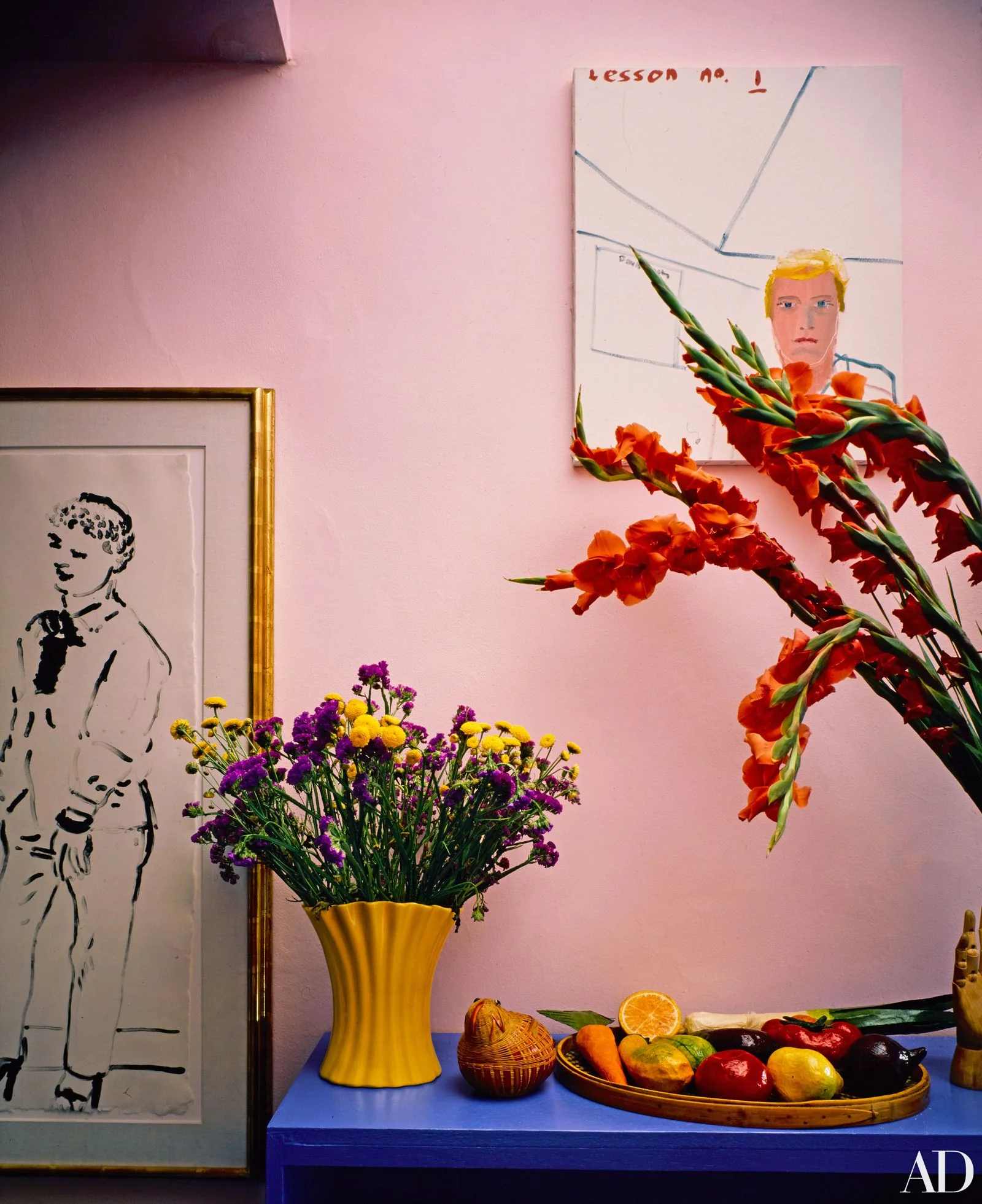
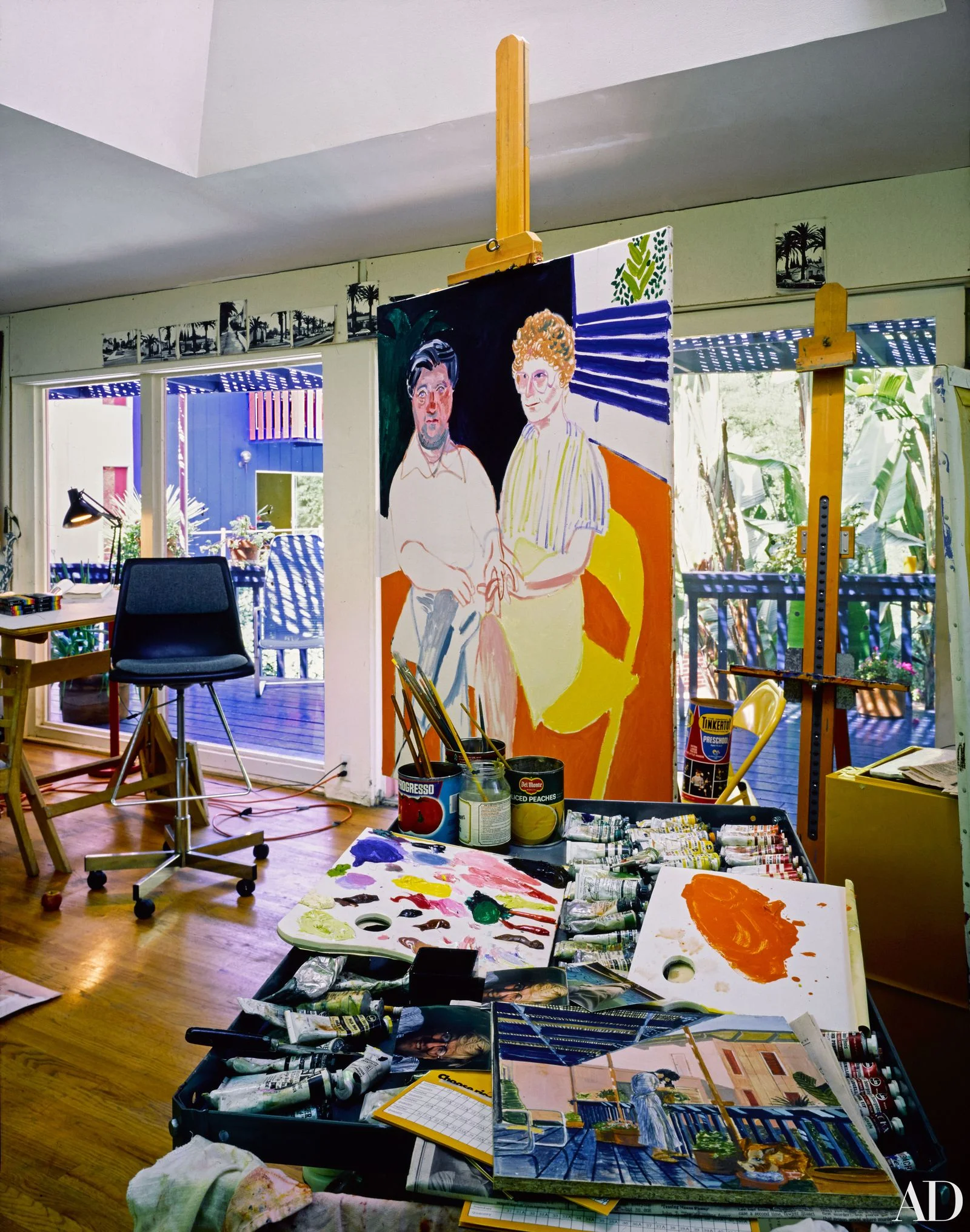
The house wraps languidly around an azure pool outlined by a snaking brick wall. Because the natural brick did not provide the color contrast Hockney envisioned, it has been repainted a vivid red and white. Now it parodies its more bland existence and reiterates motifs from his sets for The Magic Flute and Roland Petit’s ballet Septentrion. Though not a conventional studio, the living room vibrates with activity. Recently completed paintings, photographs, drawings, and works in progress—randomly juxtaposed—symbolize the frenetically creative life of David Hockney. Visitors gingerly pick their way through the cluttered workspace, opera blares from a hidden speaker, conversation is at a high pitch, but work—the pivotal element of Hockney’s existence—goes right on.
David Hockney is—by his own admission—an intensely private, shy person, yet his friends are legion. Thus, his house, a colorful fantasy made real, never lacks a corps of visitors and admirers—prompting his British friends to refer to it as “Mont Hysterical.” It is indeed a house filled with the larger-than-life personality of David Hockney, who says, “It is the spirit you fill it with that is important. That spirit is in the house, but of course color helps the spirit.”