Risk of WRB being wrapped onto sill under DuPont FlexWrap sill flashing?

What are the wall assembly water and moisture damage risks due to WRB being wrapped onto the rough opening sill of our window openings and DuPont FlexWrap wrap being applied over the WRB and both layers stapled to the wood sill?
Where we have windows whose tops are relatively close to extended (2′ or greater) roof overhangs, is the risk minimal?
If the risk to some of our windows is significant over a longer period of time, is there any solution short of removing the affected windows, properly performing pre-window install flashing, and reinstalling the windows?
Background
We’re building a new home in the high desert climate of Central Oregon. We’re using DuPont DrainWrap as the WRB and DuPont exterior flashing tape products. The windows are Marvin’s new Vivid line with Ultrex fiberglass exterior and fiberglass interior (no wood).
The Vivid windows are flanged, but the flanges are not an integral part of the design. Consequently, exterior head and jamb flashing using DuPont Flashing tape is required to be rolled onto the sides of the window frames to help protect from water intrusion between the flanges and frame.
The current plan is to use metal drip flashing above the exterior window casing, but not also directly on top of the window frames.
Our siding and trim will be Hardie Artisan horizontal lap and vertically installed v-groove with 1.5″ thick Artisan trim board around all windows. The Artisan trim will sit proud of the 1″ thick Vivid window frames.
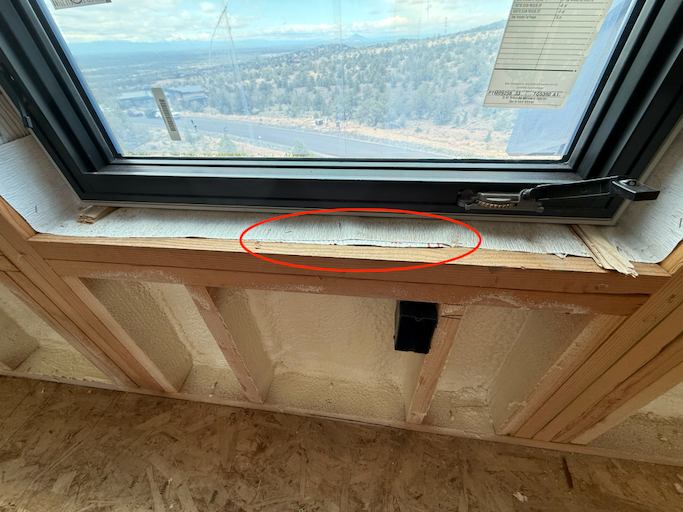
Unfortunately, although the framing crew who installed the windows demonstrated to me the proper “I” cut technique for the WRB on one window, they did not cut the WRB at the edge of the window frame sill in many of the other windows. Instead, they wrapped the WRB over the top of the sill and then applied the FlexWrap as the sill flashing on top of the WRB. They then stapled the two layers to the wood sill.
The window rough opening sills do not have a sloped outward drainage plane.
On the exterior, I will ensure that Marvin and DuPoint installation instructions are followed for the flashing of the jambs and heads along with proper tape sealing of WRB cuts.
On the interior, I plan to use low expanding spray foam in the window frame to rough opening gaps and use Siga Fentrim IS 20 acrylic backed tape to air seal between the window frames and the sides of the rough openings. I am debating as to whether or not a foam backer rod on the exterior edge of the window to rough opening gaps is necessary.
The Fentrim tape and foam would be applied to all 4 sides of the windows. If an backer rod near the exterior would be useful, it’s not clear to me that it should be installed on all 4 sides of the windows or just the heads and jambs. I’d also like guidance as to how far the backer rod should be pushed toward the exterior window flanges.
e.g. Inside – Fentrim tape (air seal) – low expanding spray foam (add some R value) – backer rod (useful? purpose?) – window flange – outside
GBA Detail Library
A collection of one thousand construction details organized by climate and house part

Replies
ckamps64,
I think it's fine. While not your preferred technique, what you are describing is quite common, and performs well. The only spot where lapping the WRB into the RO matters a lot is the head if you don't run the head-flashing under it.
The sill-pan can be applied over the WRB. As the sill is not sloped, make sure to include a back-dam.
Thanks Malcom.
Given that our windows are already installed, I assume that we can implement a sufficient back-dam by installing a backer rod under the frame and up the jambs a few inches followed by applying a suitable sealant on the interior side of the backer rod. The backer rod + sealant will be installed near the interior edge of the window frame to maximize the amount of drainage to the exterior via the open sill area.
(We'll still fill the rest of the window to RO jamb and head cavities with low expansion spray foam and air seal around the entire frame using Siga Fentrim tape).
ckamps64,
In my experience, especially with windows afforded some protection by nearby overhangs, the moisture damage that occurs to the framing around windows is almost always on the corners where the jambs and sill meet, and is the result of persistent low-level water intrusion.
As long as there is a sill-pan, this incidental wetting causes no problems. Making sure there is a path to drain by not taping the flanges at the sill is to me more important than whether the sill is sloped. The back-dam is ideally the sill-pan turned up on the inside face of the window frame. Backer rod and sealant will work if that's not possible now.