Encapsulation can make a crawlspace part of a home’s conditioned enclosure, but it also changes how people maintain and work in the space. Planning for lighting, power and a possible soil-gas vent while the work is underway can reduce later disruption. For homeowners, the case is practical: easier access for service workers, a nearby place to plug in tools, and a simpler path to radon mitigation if testing shows it’s needed.
These additions won’t make sense in every crawlspace. A small area with few pipes or mechanical systems may rarely need attention. But where HVAC equipment, plumbing or electrical work sits below the home, the crawlspace is a workplace as well as part of the building enclosure. Making it more workable can pay off over the life of the house.

Lighting makes access more useful
Service technicians often need to carry tools, parts and portable lights into a crawlspace, then travel some distance to reach the equipment or plumbing that needs attention. Permanent lighting can make that trip easier and reduce the gear they need to bring. It also means a worker is less dependent on battery-powered lights while moving through a confined area.
That convenience matters most in long or awkward spaces, where a technician may have to crawl around multiple turns. In a small crawlspace with little equipment, the benefit may be limited. But when someone does need to get in, adequate light improves visibility around pipes, wiring and mechanical components.

The author added lights to an L-shaped crawlspace, including one at the far end of the space. The layout illustrates why one fixture may not be enough: light needs to reach the areas where workers will actually be doing repairs, not just the access point.
Nearby outlets can support repairs and equipment
Contractors commonly arrive with battery-powered tools, which still need charged batteries. A GFCI-protected outlet in the crawlspace gives workers a place to plug in chargers near the job. Depending on the layout, one or two outlets may also help support future equipment, such as a dehumidifier.

Placement is the key consideration. An outlet near relevant equipment or plumbing is more useful than one that can only be reached from the crawlspace entrance. The author’s new outlet is near the kitchen plumbing, an area that previously required a lengthy crawl to reach.

During a hot water retrofit in 2022, the author spent several hours crawling from one end of the space to the kitchen plumbing, then worked on the pipes while lying on his back. Permanent lighting and an outlet nearby would have made that job more convenient. The example also shows why it’s useful to plan around the home’s actual service locations.
Install a soil-gas pipe while the liner is accessible
A perforated pipe beneath the crawlspace liner can provide a route for soil gases to vent outdoors. Including that pipe during encapsulation leaves the option available if radon testing later indicates a need for mitigation. It’s a preparatory step, not a claim that every encapsulated crawlspace will have high radon levels.
Radon originates in the ground. Air movement in a vented crawlspace can help keep it from accumulating in the air that reaches the home. Encapsulation changes the airflow and soil-gas conditions: the crawlspace becomes more connected to the home’s indoor air, and radon can still enter from the soil. A home’s radon levels may therefore change after encapsulation.
Putting the pipe in during the encapsulation work avoids cutting into the liner later. If testing shows elevated radon, the under-liner pipe can be connected to an exterior vent that runs upward. A fan can be added if passive venting isn’t sufficient. Homeowners can test for radon to determine whether further work is warranted; more background is available in this guide to radon mitigation.
The author’s experience makes the sequencing issue concrete. The home’s crawlspace was encapsulated in 2015, while the soil-gas vent was installed this year. Adding it later meant cutting and resealing the liner, and the repair proved difficult to seal. The vent pipe is visible as a raised section beneath the plastic in the lighting photograph. Doing the preparatory work during encapsulation can avoid that extra intervention.
Costs and when the upgrades fit
Against the cost of encapsulation, these additions are relatively modest. The article estimates that adding a soil-gas vent pipe during the main work should cost no more than a few hundred dollars. Having an electrician install wiring for several lights and outlets could run from a few hundred dollars to about $1,000, depending on local costs. Those figures are estimates, not a quote for any particular property.
Not every crawlspace needs lights or outlets. A small space with no ducts or HVAC equipment and little or no plumbing may go a decade or longer without needing a worker to enter. In that case, the convenience may not justify the added work. The soil-gas pipe serves a different purpose: it preserves a potential route for radon mitigation, even if no venting system is needed immediately.
Some new homes and certain renovation projects already require a switched light and an electrical outlet near equipment under the National Electrical Code. For many existing homes, those features would be additions. The relevant question for an owner is how often workers are likely to enter, how far they must travel, and what systems they may need to service.
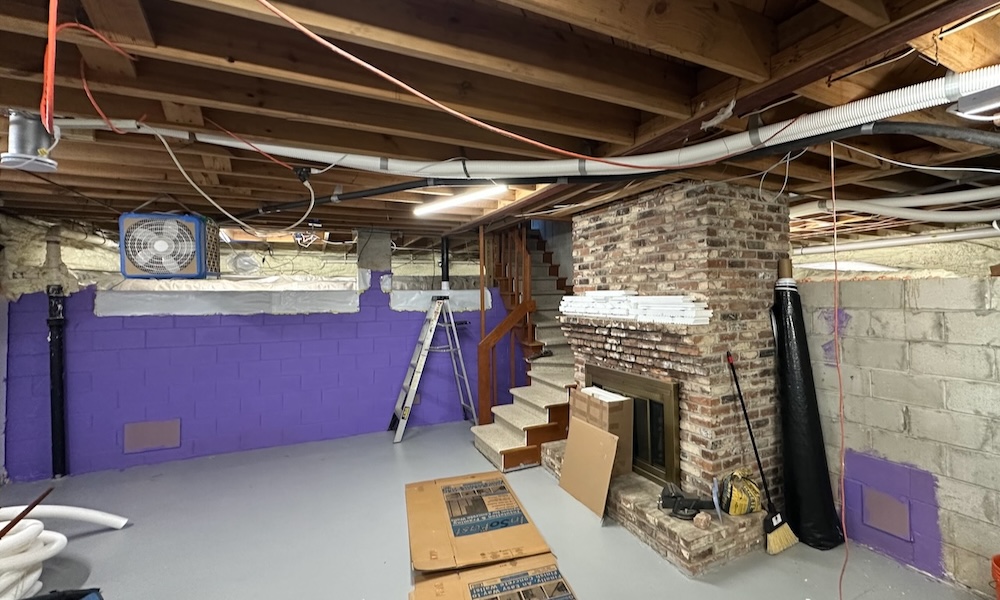
For crawlspaces that regularly house mechanical systems or plumbing, planning ahead can make future maintenance less cumbersome. Lighting and outlets improve access for work; a soil-gas pipe can make later mitigation simpler if test results call for it. The author’s broader renovation continues in the basement area connected to the L-shaped crawlspace. The mechanical and plumbing systems are already in place there, with framing, electrical work and finishes still underway.
As encapsulation closes off the soil and changes the crawlspace’s relationship to indoor air, it’s a useful moment to consider both future service needs and what testing might reveal. A few planned additions can leave the space easier to work in and better prepared for the next stage of home maintenance.
Allison A. Bailes III, PhD, is a speaker, writer and building science consultant, and founder of Energy Vanguard in Decatur, Georgia. He has a doctorate in physics and is the author of a book on building science. He writes the Energy Vanguard Blog. He can also be found on LinkedIn, and at Energy Vanguard’s newsletter and YouTube channel.