Insulating @ eave- detail advice

Hello,
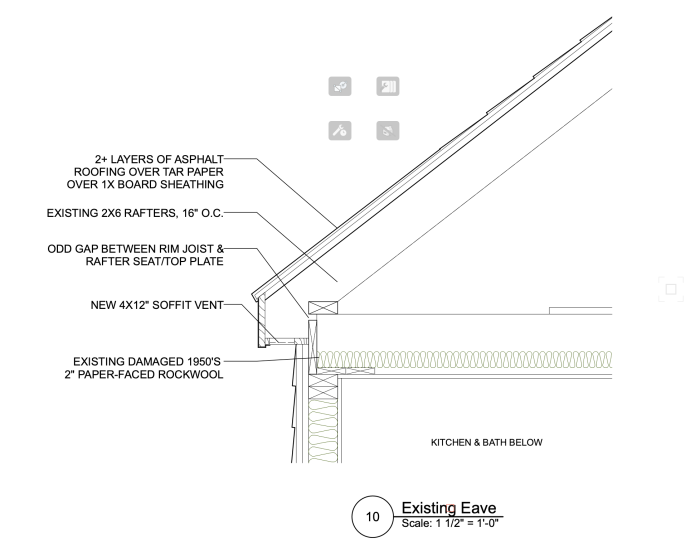
I posted a few weeks ago and got some great responses re: my overall approach to insulating the attic of a 1950’s colonial. This is a DIY job limited to attic but I am trying to do the best I can to create a air vent channel below the existing roof board sheathing and insulate with a series of 2×4 walls and mineral wool.
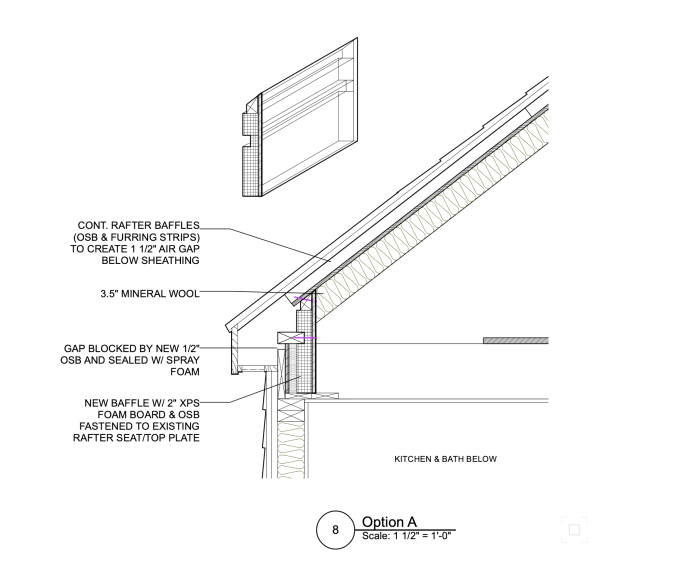
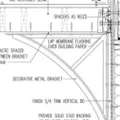
Based on advice from another member, I changed course and eliminated all foamboard. I already bought a few sheets of foamboard however, and want to use it to create a baffle at the plate/rafter seat using OSB and XPS. The OSB is to control air and the XPS portion is useful for minimizing the cold bridge at the top plate of the first floor.
My first question is- HAVE I GONE TOO FAR? These OSB/XPS sandwich baffles will take a lot of time to make, especially considering the variance in rafter spacing (between 12 and 16″ O.C.). This is a critical detail though, and this house happens to have an odd gap between the rim joist and the rafter seat (shown in the drawings).
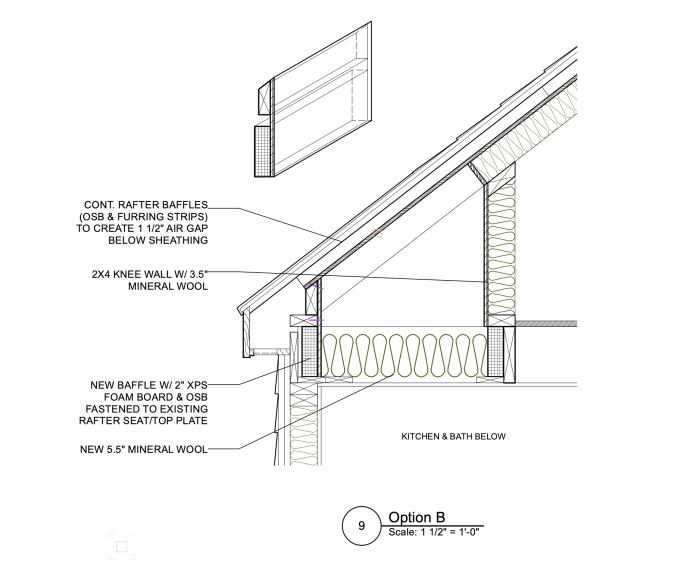
My second question is- Option A or Option B? Im leaning towards Option B.
Thanks!
GBA Detail Library
A collection of one thousand construction details organized by climate and house part

Replies
User...688,
If you are going to go with option B, I would start the baffles at the knee-wall, and run the OSB along the ceiling joists. The way you have it, the space is neither entirely in nor out of the building's enclosure. It's not conditioned, but neither is it vented. Those spaces can be behave unpredictably.
I still prefer option A. It offers a clearer boundary with less complications.
On both options:
- I would forgo All the OSB except on the floor and substitute house-wrap.
- I'm not sure the OSB inside the foam blocking at the eaves adds anything.
" It's not conditioned, but neither is it vented. Those spaces can be behave unpredictably."
This is interesting, and something I didnt fully consider.
"- I would forgo All the OSB except on the floor and substitute house-wrap.
- I'm not sure the OSB inside the foam blocking at the eaves adds anything."
The OSB is really there for rigidity and ease of manuevering. To access this space, Im basically laying down and using a 12" bit extender on a drill to fasten to the rafter seat. Though to your point, if I use thicker foam (and buy more of it) I would probably wrestle the baffle less and not have to use OSB (which Im never completely comfortable using in the first place).
The only thing I really dont like about Option A is hand-cutting a bevel into the foam for the top of the baffle. I will have to make about 60 of these......
Thank you for the feedback! Back to the drawing board....
User...688,
Part of the reason I suggested forgoing the OSB was that baffles and the covering outside the knee walls would benefit from something more permeable. Maybe consider fiber-board instead?
The foam blocking doesn't need a bevel cut. The edges on all four sides get canned foam to complete the air-sealing.
Excellent. Thanks!