Advice for reducing sound from HRV return ducts

We are rebuilding a 572 sq. ft 1948 cottage in Eugene, OR. We’ve done a good job making the cottage airtight, and for air quality have installed a Broan AI Series B150H75NT.
When we commissioned it, we’re getting excessive sound from the two vents of the return ducting. That ducting is very simple: All 5″ rigid. The two legs from the vents come to a 6″-5″-5″ wye, then a 6″->5″ reducer to the unit’s 5″ port. The unit is intended to run 24×7 at it’s lowest speed of 35 cfm.
Frequency tests and a few experiments suggest the noise arises from the mechanical noise in the unit, rather than turbulence or vibration in the ducting.
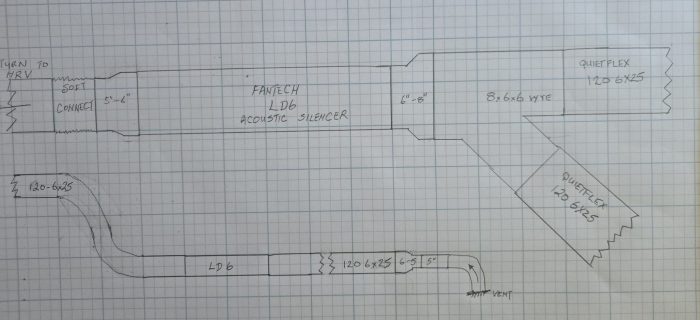
My tentative plan is to replace the rigid metal with the following sections from the HRV port to the bathroom ceiling. (Keep in mind that the airflow is from the vent to the HRV port.) I’ve attached a drawing. Note that I’ve since made a few mods to the path and added the IR6 damper.
This section is “locked in” from the initial install:
HRV 5″ vertical port => rigid metal 1D 90° turn, 2′ of 5″ metal duct across the top of the HRV
NEW ducting:
=> Short, flexible 5″ canvas connector => 5″-6″ increaser => 6″ Fantech LD6 Acoustic Silencer => 6″-8″ increaser => 8″x6″x6″ wye => Two legs “A” and “B”.
Leg “A”: 6″ Quietflex 120 6″ flexible duct … 1.5D 90° turn (down) … 1.5D 90° turn (across rafter ties) => Fantech IR6 “iris” damper => Fantech LD6 Acoustic Silencer => 6″-5″ reducer => rigid metal 1.5 D 90° turn (down) => 5″ vent & grill.
Leg “B” would have a similar sequence, but slightly different geometry.
I’d appreciate any advice on elements and layout.
And yes, if I’d only known, I would have initially run a complete 6″ acoustic flex with silencers and at least 1.5D turns.
GBA Detail Library
A collection of one thousand construction details organized by climate and house part

Replies
Those in-line mufflers are extremely effective. I would swap out a section of the 5" before it splits off and install a 5" muffler in there and see how it sounds.
If that is still loud you can always replace the last run of 5" before each vent with a 5" flex. As long as the flex is mostly straight, it won't restrict flow.
Thank you. The tentative plan increases to 6" then installs a 6" Fantech LD6 Acoustic Silencwer before the wye.
x2 on the Fantech silencer if you want an out of box solution. I have built quite a few DIY duct silencers in my shop. I use them for home theatre isolation, kitchen venting, and the HRV. These are a few that I've built:
https://www.garagejournal.com/forum/threads/woodys-works-garage.263351/post-6096192
On the theater setup, I did a lot of back to back acoustic testing before/after and am still amazed by how simple these are, and how well they work.
The nice thing about custom building (maybe 20 minutes per unit to build) is that you maximize length which improves performance :-)
Dennis, The thread you linked to is very cool! In my case, buying the Fantech LP6 acoustic silencers lets me address the multiple other "surprises" on our "Money Pit Cottage" project.
BTW for a new house we built 10 years ago, I got really good advice from an acoustic engineer to isolate a bedroom with a shared wall with the garage. Absolutely, dead silence in the bedroom, regardless of what's going on in the garage.
I'm hoping the results on the ducting will also be good.
Use a few feet (I like around 2-3) of flex duct between the unit itself and the attachment point to the rigid duct system. Do this for all four ducts going to/from the unit. For this particular application, the fabric-style flex duct is better than the aluminum stuff, since you want to limit sound transmission. Remember to insulate the ducts that go outdoors -- the insulating sock isn't a significant contributor to noise transmission, but leave it a bit loose here and don't pull it too tight.
The ductwork will stop *conducted* sound, which is carried by the duct itself. It will help a little with sound carried by the air in the duct too, but those mufflers atre sometimes better for that. You can easily combine a muffler AND some flex duct, which is often the best option to really quiet down your system.
I would differ from Akos here and try a section of flex duct first, because it's cheaper than a muffler. If the flex duct alone doesn't make enough difference, you can add the muffler afterwards, and the flex duct will make the installation of the muffler easier.
Bill
Thank you, Bill.
Unfortunately, without "heroics." I need to leave the installed HRV 5″ vertical port => rigid metal 1D 90° turn, 2′ of 5″ metal duct across the top of the HRV.
My "theory" is that the flexible connector and subsequent flax and acoustic silencers will still be adequate. This being the "Money Pit Cottage" project, the cost of materials isn't a limiting factor. I want to do all of it so I can keep moving on all the other critical path tasks.
One new piece of information: Google AI recommends: "To maximize acoustic drop without destroying your HRV’s static pressure, follow this exact layout configuration for your 6-inch lines: At least 3 feet of straight acoustical flex ducting, but no more than 5 feet because the inner core is perforated and flexible, long runs create significant friction loss. Exceeding 5 feet will spike your system's static pressure, forcing the HRV motors to run harder, which inadvertently creates more noise."
My "theory" is that upsizing to 6" for most of the run will compensate for the longer runs of acoustic flex. IDK if that would be true. (The Broan does maintain constant cfm so the more flow resistance, the harder the motor works.)
See my post #7 on the duct mufflers. Upsizing to 6" is a good idea and will increase noise amelioration.
The inner core isn't really "perforated". You do get some added benefit going up a size and then back down though, so you could go from 6" to 8" and then back to 6" after a few feet. That's how mufflers work.
BTW, I've been playing with Google's AI tool a bit for some design work. Be careful with it. I have had it give me some bad info, as in "let out the magic smoke" level bad info. It's an awesome time saving tool, but it's not perfect, it makes bigtime mistakes sometimes and tells you everything is solid when it's not. I use it as a tool, but I'm not worried about it taking over the world anytime soon :D
Bill
I had this exact same problem but with the supply duct. I tried to save $30 and went with uninsulated flex duct. It was noisy. I switched to r6 insulated flex duct and the noise went away.
I'm hoping my approach will do the same. I was puzzled that the two return ducts were the loudest. I think the reason is they have shorter length and more direct paths to the vents.
I ran 6" rigid metal duct throughout our home and was dismayed how much of the fan motor noise I heard. On the advice of my HRV advisor I added 2 short sections of flex duct(supply and return to the living space) and was amazed at how much quieter it was.
That's good to hear! Thank you.
Those short sections of flex duct are acting like "vibration isolators", cutting down on conducted noise carried by the walls of the rigid duct itself. I suspect there is also some extra turbulance introduced into the airstream by the sprial reinforcement and irregular surface of the flex duct too that also helps.
Bill