Your Ducts Work Better With a Variable-Capacity System
Variable-capacity heat pumps improve more than comfort; they also improve duct performance.

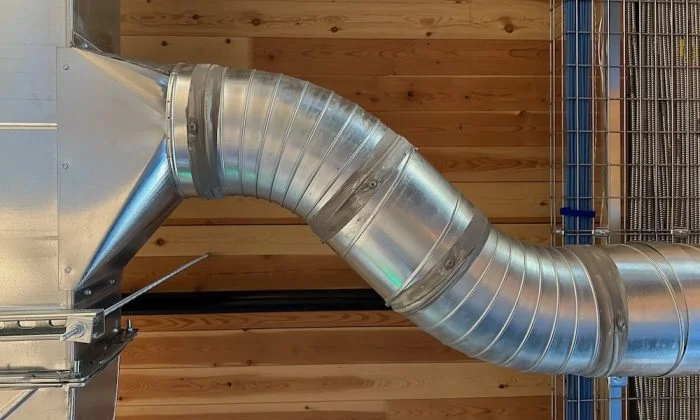
A few weeks ago I spoke with one of our HVAC design clients. He’s in the middle of getting his systems installed and had some concerns. We provide a list of dos and don’ts for changes the installers can or shouldn’t make during installation of our designs, and he wanted to get our take on the installation in progress. Fortunately, the design we provided him included variable-capacity system heat pumps. Those systems make things easier, so let’s take a look at how they can help a duct system perform better.
Fixed-capacity system airflow problems
Heating and cooling systems have two basic components. There’s the part that makes the high or low temperatures to heat and cool the house. That would be a heat pump, air conditioner, or furnace. And then there’s the part that picks up the warmth or coolth—yes, it’s a word—and distributes it to the house. In a forced-air system, the second part is the blower and duct system.
With a fixed-capacity heating and cooling system, there are only two modes: on or off. When the system is running, it blows as much air as it can. With that type of system, you have to design and install a duct system capable of moving that amount of air.
Unfortunately, many fixed-capacity systems have ducts that are too small and have too much resistance. The ducts that were in the Energy Vanguard office when we moved there in 2017 rattled when the system came on. The ducts in my house whistled when I bought it. The air coming out of some vents in other houses I’ve worked on in the past can roar, especially with poorly designed central returns.
These systems have one airflow rate, and the duct system either works with it or it doesn’t.
Why we design with variable-capacity systems
Most of the HVAC systems we design at Energy Vanguard are variable-capacity heat pumps. We also do furnaces and air conditioners, and we do multi-stage and fixed-capacity designs sometimes too. But variable capacity is our specialty. Our take on this technology is that your heating and cooling loads go up and down throughout the day and the seasons, and so should your heating and cooling capacity. That’s the benefit of variable capacity that many people know about.
It’s better for comfort. It’s better for noise. It’s better for efficiency. But it’s also better for airflow, a significant second benefit.
Airflow, velocity, pressure, and resistance
To explain why a variable-capacity system is better for airflow, I have to talk about a little physics here, but I’ll keep it simple. First, airflow is the volume of air moving through the duct. This is one of the primary variables we use in designing a duct system. The manufacturers give us data on the airflow from their equipment. We use that and the results of the load calculation to size the ducts. In short, we need the amount of airflow that will deliver the right amount of heating or cooling to each room.
To size the ducts to deliver that airflow efficiently and quietly, we have to bring in the resistance the air encounters throughout the duct system. The physical quantity we use in the calculations—and can measure in the real world—is pressure.
As air moves through a duct—including the fittings, filters, coils, and other components—it loses pressure due to resistance. Now here’s the important fact, which comes from one of the three engineering fan laws and the Darcy-Weisbach equation:
Changes in pressure are proportional to the square of changes in airflow rate.
If you double the airflow, for example, the pressure will quadruple. Cut the airflow in half, and the pressure will drop to a quarter of what it was. (I put the statement above in terms of airflow rate, but technically it’s air speed.)
Now we’re ready to apply this to variable-capacity systems and their ducts.
Why a variable-capacity system is better for airflow
What I wrote above gives you the answer, but let me make it more accessible here. When we design the ducts for a variable-capacity system, we design them for the maximum airflow. That keeps the ducts from rattling, whistling, or roaring when the unit runs at high speed.
But a variable-capacity system should almost never run at high speed. As mentioned, that’s the first benefit of a variable-capacity system. You have the capacity when you need it, but it also can ramp down to better match the actual load.
And when the heating or cooling capacity ramps down, guess what else ramps down? The airflow. The mathematics amplifies the benefit of lower airflow. Let’s say the maximum airflow of a system is 800 cubic feet per minute (cfm). When it ramps down to, say, 400 cfm, the resistance in the ducts is cut to a quarter of the resistance at max airflow.
My phone call with the client
This second advantage makes phone calls like the one I had last week a lot easier for us. The client I mentioned in the introduction sent me some photos of the installation, pointing out changes to the design made by the installers.
The ducts were sheet metal and looked good. But he was worried about one place in particular where the installers had added two 90° elbows. That’s one of the things on our “Don’t do without consulting us” list for field changes.
I told this client that the two extra elbows would have practically no impact on the performance of his system. The other changes he showed me also should have no effect on the airflow in his house. The fact that the system will spend most of its time running at low speed provides the cushion needed for changes like that.
An important caveat
The fact that variable-capacity equipment can make poorly installed ducts work better comes with a caveat. Going with variable capacity does NOT give the installer permission to be sloppy with the ducts.
Starting with a good design and then sticking closely to it is still necessary for moving the right amount of air to the right places. Otherwise, you may end up with a sloppy installation and airflow imbalances that affect comfort. On top of that, you still want the ducts to perform as they should on those rare occasions when the system does run at its highest airflow.
So what?
Going with a fixed-capacity system means the duct system has little margin for error. It must be designed to deliver the maximum airflow at all times—because that’s what it’s moving anytime it runs.
But a variable-capacity system is forgiving. It runs at lower speed most of the time, and that lowers the resistance to airflow. This mathematically amplified benefit of the relationship between air speed and resistance is a powerful tool in the toolkit of the HVAC designer—and a boon for homeowners who will enjoy efficient, quiet airflow they won’t even notice.
Allison A. Bailes III, PhD, is a speaker, writer, building science consultant, and the founder of Energy Vanguard in Decatur, Georgia. He has a doctorate in physics and is the author of a bestselling book on building science. He also writes the Energy Vanguard Blog. For more updates, you can follow Allison on LinkedIn and subscribe to Energy Vanguard’s weekly newsletter and YouTube channel.
Weekly Newsletter
Get building science and energy efficiency advice, plus special offers, in your inbox.


