Led strips on a ceiling beam

I am trying to come up with some lighting ideas for the living/dining room in our new home.
I’m not a fan of downlights, except as task lighting (lighting part of a wall, lighting kitchen counters, etc.). So the plan for the living space is to:
– wash the ceiling for indirect light
– use a few recessed downlights for highlighting a few wall areas
– a large pendant above the dining table
– a few floorlamps by chairs/sofas
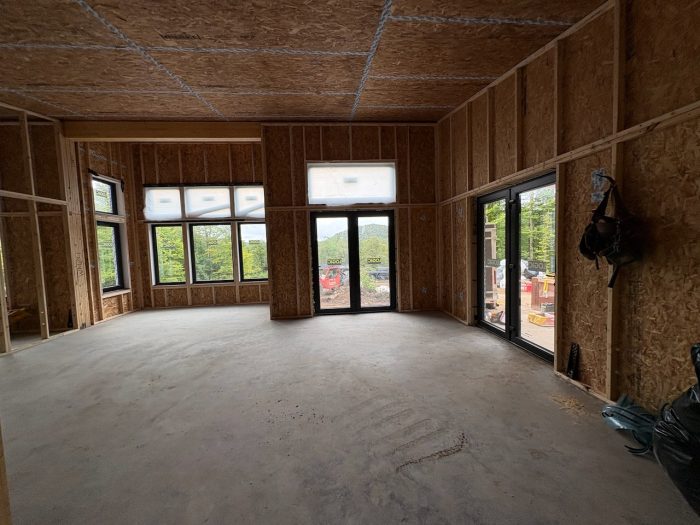
The dimensions of the dining/living space are 16×24, and the ceiling slopes upwards from about 10′ to about 14′.
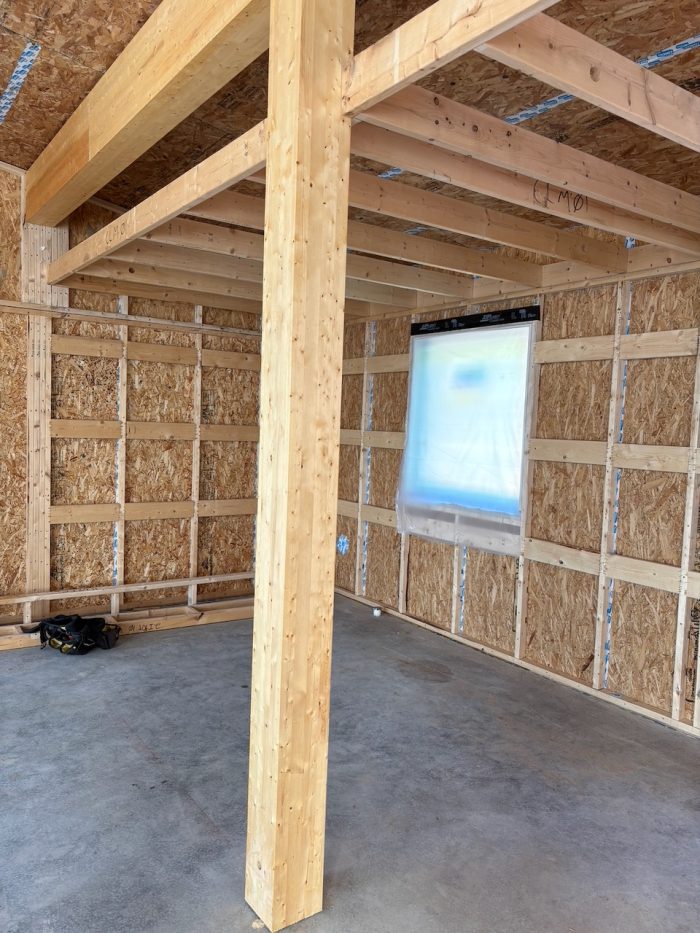
There are two large pine beams (laminated), one at the front, and one at the back of the space, and I’m struggling with how to unobtrusively incorporate LED strips to light the ceiling.
On the side walls, I can just use coves, and install tracks, diffusers, etc., but I don’t think that will provide enough coverage, so I wanted to throw some light from the beams as well (plus possibly light up the beams as an added bonus).
Does anyone have any ideas for a good way to do this? I’ve been thinking that maybe attaching a thin layer of pine to the bottom of the beam, a little wider than the beam itself, might work, but that might not hide the strips from view. Or perhaps some kind of L-shaped bracket?
Any help with that, and any general advice would be appreciated!
I’ve attached two pictures, one of a part of the beam at the lower end of the ceiling, and one giving an idea of the size of the ceiling (you can also see the smaller beam at the front end of the living space, by the windows).
Thank you!
GBA Detail Library
A collection of one thousand construction details organized by climate and house part

Replies
We do this using an L-shaped wood trim, with a lip just high enough to hide the tape light. I recommend either using an angled housing or placing the tape on an angled strip of wood.
I've learned a lot from David Warfel, including on a project we did together that incorporated this detail. Check out his various articles and videos here and on his website: https://www.finehomebuilding.com/author/david-k-warfel.
He has also been on the talk show I co-host three times and shares a ton of good info, but I don't recall how specific he gets about this kind of detail: https://www.youtube.com/@thebsandbeershow4723/search?query=warfel
You can get aluminum extrusions that will house LED strips to let you make custom recessed light strips. One example is here: https://ledprofiles.com/collections/all-led-channels?gad_source=1&gad_campaignid=8364598768&gbraid=0AAAAAC_bA1RhnSEASb1RZ1YjdDvw7vjuR&gclid=Cj0KCQjwteTUBhD4ARIsAEYjs3pZaORuUmMjd8T_DobvNrAQ3gcbgp6kWOIEdIS0np-N1vNCDibWWc4aArC4EALw_wcB
If you do a coffered ceiling, you can hide the cove strips in such a way that you light the "panels" in the ceiling, making a nice, diffuse, indirect light source for the space. I don't have a pic handy, but I know of one place that did a mural on an arched ceiling, Sistine Chapel style, but with a "cloud and sky" type of look, then reflectively lit that with cove lights. You can be really creative these days due to how much light you can get in the tiny LED strips.
You can also do a luminuos ceiling, or some variation on that. These nifty LED systems are known as "LED Channel Lighting Systems", and have a *lot* of options. One of my favorites are the various crown moldings with integrated LED strips. You can even get crown mouding profiles that can be mudded into the corners similarly to how you install plastic corner bead. Do a few google searches for some of those terms and a lot of options will come up.
BTW, make sure you allow for dimming of these systems. You can get creative with variable color temperature setups too, which can be great if you want it bright sometimes and candle-like others, or you can go all out with an RGB system and really get crazy.
Bill
Hi Michael,
Thank you, that's very helpful.
In fact I'm a big fan of BS + Beer, and I very much enjoyed the episode with David Warfel. Particularly his suggestions for centralized low-voltage controllers.
So thank you for all that you do to spread the light about building science!
I've also learned a lot from David's website. He even has an article somewhere where he says something like, "adding a tiny shelf to the bottom of a ceiling beam." But I am having trouble, as you guessed, finding any details on implementing this kind of idea.
Is the L-shaped trim you mentioned simply two pieces of rectangular moulding trim, one tacked on to the beam, and the next tacked onto the first, creating the L shape?
Allister
Hi Bill, thank you for those ideas, I'll check them out. And I 100% agree about the importance of dimming and color adjustment. That's part of the reason I find the centralized low-voltage systems so interesting, because they make that so easy (I hope!). I'm looking at the system from ATX-LED for example.
Allister