LED lights and vapor barrier in cathedral ceiling

Hello! Finally getting to wiring and lights! Making finals decisions on everything now as well as trying to anticipate and plan for everything is fun getting exhausting 🤪 The last time I wired a house it was pretty traditional – 14/2 to switch to fixture. Done.
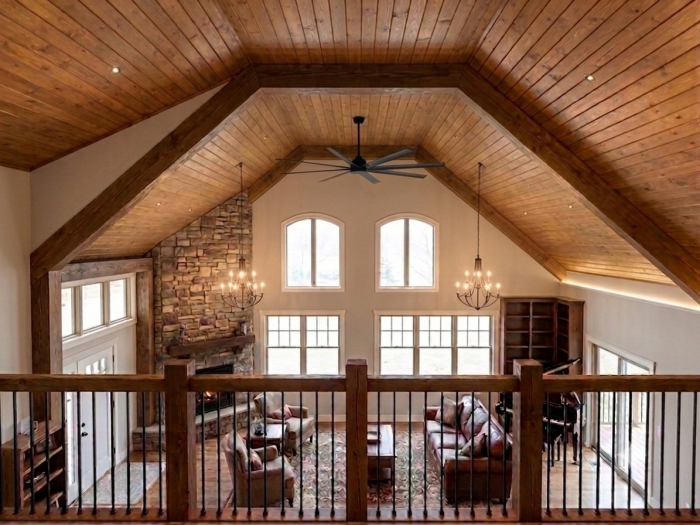
Been doing a whole lot of lighting research. Appreciate all the help here, the BS+Beer podcasts, and more recently AI (with some mixed results…). That said I’m settling on what I’d like to do, but need to confirm feasibility and planning. The main floor is roughly 30’x40’. The 30’ tall gable wall faces SSW and has a lot of windows and natural light. The side walls are 10’, then a 10/12 pitch to a flat ceiling 20’ up. I know we’re not huge fans of cathedral ceilings, but here we are… the north end is the kitchen and will be under a loft that extends about 10-12’ into the room leaving a roughly 30’x30’ living room space.
trying to layer the light so planning on some kind of recessed light in the vault, 2 chandeliers left and right of center, cove lighting at the intersection of the wall and ceiling, and floor lamps. The kitchen will have recessed lights, 2-3 pendants, under cab, and toe lights.
There is also an open stairwell that I’m considering adding tread lights to and will have some sconces at the top.
if needed I could easily wire everything traditionally and use some dim to warm lights. But got a few reservations. Looking for advice on two specific challenges and any other recommendations:
### 1. High-Ceiling Lighting Strategy & Low Voltage Options
My local electricians only recommend traditional flat, canless LED lights. I have two concerns: the 40-degree ceiling angle will not light my floor well, and I do not want to pull out scaffolding every few years to replace dead drivers or dealing with discontinued smart-light software. I’m open to dim to warm fixtures but unsure if they will be too dim for the large space to get a time I’d want.
* **The Plan:** I want to run “dumb” low-voltage fixtures in the ceiling and home-run them back to a central control panel so all electronics are serviceable from the ground.
* **Questions:** * What are some recommended low-voltage fixtures that work well on steep slopes and aren’t too ridiculously priced?
* for this option is running 14/2 or 16/2 CL2 wire to the light zones, paired with 18/2 control wire to the wall switches, the correct way to rough this in?
* How many fixtures are actually needed? (Electrician recommends 24–32 lights; AI suggests 16 total grouped by functional zones plus the two chandeliers).
### 2. Wiring a Tongue & Groove Ceiling Without Ruining the Vapor Barrier
The ceiling finish is pine tongue-and-groove. To meet code, I must install 1/2” drywall behind the pine as a fire barrier.
* **My Idea:** Install the vapor barrier (VB) tightly to the framing, then the 1/2″ drywall, followed by 1.5” furring strips, and finally the pine. This creates a 1.5” service cavity to run all lighting wires without puncturing the VB.
* **Electrician’s Idea:** Use standard round boxes with flanges, run the VB, install drywall, cut out the holes, and let the drywall pinch/seal the VB to the box.
* **Questions:**
* Is a 1.5” service cavity deep enough for typical sloped/low-voltage fixtures, or will I end up cutting into the vapor barrier anyway for depth?
* Is building a service cavity overthinking it, or is it a better best-practice for air sealing than the electrician’s method?
GBA Detail Library
A collection of one thousand construction details organized by climate and house part

Replies
I can answer a few of your questions.
There are several brands of low-profile, recessed LED fixtures. If you watched the BS+Beer shows with David Warfel, you understand why they aren't ideal in terms of lighting quality, but we use them regularly anyway, especially in utilitarian spaces. I installed a couple of these in our house: https://www.homedepot.com/p/HALO-RA-4-in-Integrated-LED-Recessed-Light-Trim-600-Lumens-900-Lumens-5-Selectable-CCT-D2W-120-Volt-DM-RA4LS9FSD2W1EWHDM/327122595. They swivel up to 35°, which isn't quite enough for you but it's not far off. There are others, such as this one I have not used, that tilt more: https://www.maxximastyle.com/4-in-adjustable-slim-recessed-led-floating-gimbal-downlight-850-lumens-color-selectable-2700k-5000k-black-trim-mrl-s41255b/.
I used 14/2 which is required with the type I linked to that has a driver at the fixture. At last year's Fine Homebuilding Summit, David's presentation was on using low-voltage wiring for most or all lights; that's still a cutting edge solution but perfectly rational if you can do it properly.
Step lights at stairs are very effective. We like having them on the wall next to the stairs, where they cast a wider beam than having them on every step so we can get by with just a few.
The standard/old way to calculate how many fixtures you need is to multiply the desired foot-candles by the room area to get the total amount of lumens. That's still a reasonable starting point, if you want even illumination everywhere. As David described in his BS+Beer appearances, there are other, often more effective ways to design lighting, not least of which is focusing the lighting where you need it or want it, rather than pointing all the lights down so the space feels like a Walmart.
A 1.5" service cavity is just enough to meet code, if the wiring is all tight to the drywall. If you want to maintain the integrity of your air control layer and prevent long-term moisture issues (and ice dams, if you get much snow) I would not rely on the electrical boxes for airtightness. We often have builders make recesses for lighting fixtures, but it's extra work. For surface-mounted fixtures, there are plenty of options for boxes that would fit fully on the interior side of the drywall.
Michael,
Thanks for posting that - I just ordered some similar 2" gimbal lights from MaxximaStyle to try out on my own remodel. Decision was based entirely off of the 2" size, the gimbal range (going in a 3:12 drop lid), and how how recessed the actual light source is even when gimballed... oh, and price). Validating to see that you use lights from that company as well - I was worried I was maybe letting price dictate my choice too much.
Paul, I was careful to add that I have NOT used that brand, and to me the price is suspiciously low, but hopefully they work out for you!