Radon Mitigation Basics for an Older Home
After three years of radon testing, I finally installed a mitigation system. Here’s what I learned—and how well it’s working so far.

More Building Science


I’ve been telling you the story of radon in my Atlanta home for three years now. In April 2023 I got the results of my first radon test. In July of that year I installed a continuous radon monitor to see how it varied over time and under different conditions. In early 2024 I began the renovation of our basement, which I hoped might solve the whole problem. But I was wrong. Things did improve, but recently I decided it was time to mitigate. So today let’s talk radon mitigation basics.
My radon test results
For my 2023 article I had done only a seven-day activated charcoal test. I placed the test kit on the main floor, where we spend the most time. The result was 7.7 picocuries per liter (pCi/L). Then I did a four-month alpha track test over the summer of 2023. For that test I put the test kit in the basement, closer to the source. The result was 10.3 pCi/L.
In July 2023 I installed an Airthings Space Plus IAQ monitor that also gave me continuous radon readings. Now I have nearly three years of radon data. Let’s look at them in chunks.

As you can see from the graph above, our seven-day charcoal test was pretty accurate. The periods where the radon level dropped into the green zone were times when I had the windows open in the fall.

The graph above shows our radon level for the whole year of 2024. In February of that year we began our basement renovation with demolition and asbestos abatement. From then until we got the new windows installed in September 2024, we had the basement open and ventilated with an exhaust fan almost continuously. That’s why you see the big drop in radon for most of the year in the graph above.

The year 2025 was normal. Phase 1 of the basement renovation was finished. I had sealed up a bunch of the leaks in the slab, and it made a difference in our radon level. We were down about 2 pCi/L from before the renovation.

Here are the data for 2026 year to date. Again, we’re in the mid-5s for picocuries per liter of radon.
House open or closed?
One thing you may have noticed in the 2023 and 2025 data are the dips into the green zone for radon, which means the level was lower than 3.0 pCi/L. You may also have noticed that those dips were in the fall and spring. It turns out that opening the windows in the basement and main floor is a good way to keep your radon levels down. Unfortunately, that’s not realistic to do throughout the year here in Atlanta.

The graph above shows the December, January, and February data for this past winter. As you can see, our average radon level is back to the old number when the house is closed up. So maybe the slab sealing I did during the basement renovation didn’t help that much? Maybe it’s just because I’m averaging in the low radon periods when the house is open in spring and fall.
Radon mitigation basics
When your average radon level is above 2 pCi/L, the U.S. EPA recommends doing something to mitigate it. And the thing to do is called subslab depressurization. If you’re lucky, you can do it without a fan. You install a pipe beneath the slab, and the soil gases rise passively in the pipe because of the stack effect. The passive system can work well, but it’s hard to do in existing homes—especially mine, as you’ll see below.
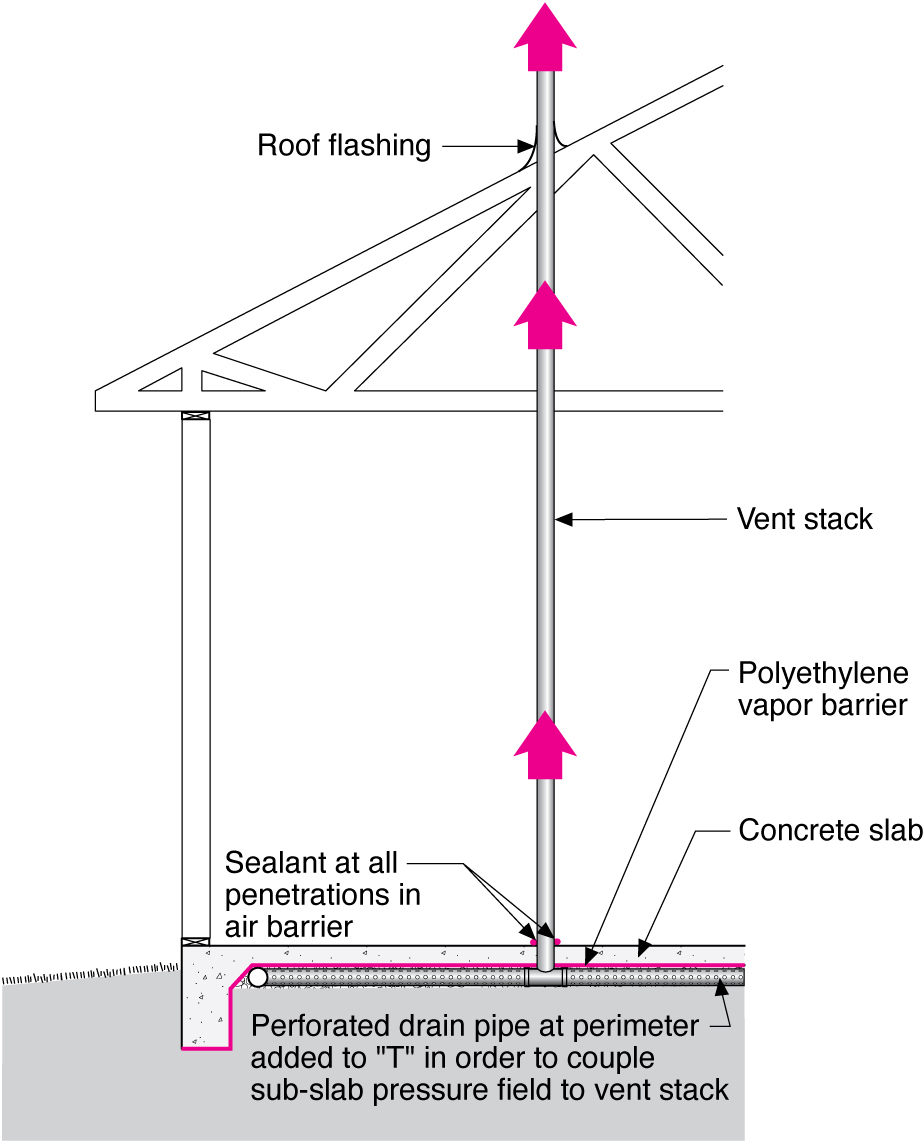
If that doesn’t take your radon down to an average of less than 2 pCi/L, then you add a fan. With active depressurization beneath the concrete slab or crawlspace membrane, you get rid of radon and other soil gases before they enter the living space.
CAUTION: If you decide to take this on yourself, make sure you understand not just the radon mitigation basics but all the details too. One thing you definitely want to do is make sure the radon fan, if you install one, is outside the living space. You want all the pipe running through the conditioned space to be under negative pressure. Otherwise, any leak on the positive pressure side of the pipe will pump soil gases—including radon—into your home.
The EPA has a detailed guide on this topic called Building Radon Out. Click that link to download it for a full explanation.
Our radon mitigation
On Monday, Smart Space Atlanta came out and installed a radon mitigation system in our home. Our house has a couple of complications that make it a bit more difficult. First, our foundation is part basement and part encapsulated crawlspace. Ideally, you’d want to depressurize the subslab and submembrane areas separately, but Smart Space has had good luck tying them together. They do have a valve that allows them to adjust how much air comes from beneath the crawlspace membrane and how much comes from beneath the slab.
Second, our 1961 house has no gravel beneath the concrete slab. No plastic liner either. And we’re sitting on the red clay of Georgia, so that makes depressurizing the subslab area more difficult.

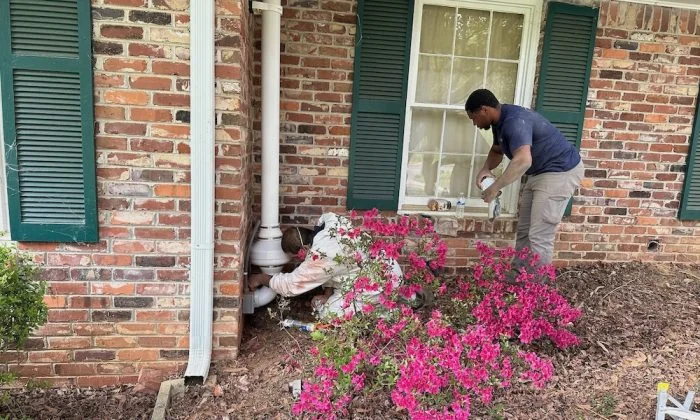
The crew from Smart Space used a concrete hole saw to drill through the slab (photo above). Then they reached in and pulled out enough dirt to fill about four 5-gal. buckets. The 6-in. PVC pipe connects to the hole, which is sealed with caulk. The crawlspace has a flexible, perforated pipe beneath the membrane. As mentioned above, the two are connected with a valve that allows for adjustments of the airflow.
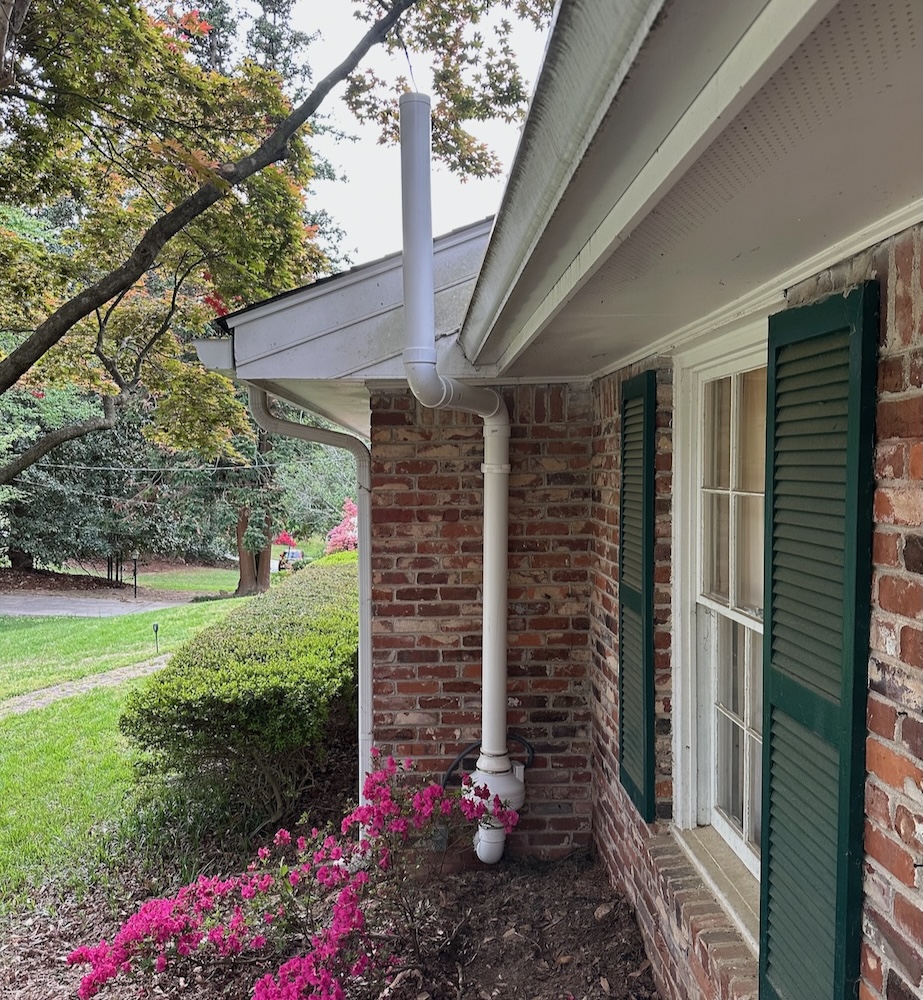
The radon fan (RadonAway RP265) is mounted just outside the house where the pipe comes through the wall. Yes, it’s on the front of the house because that’s the best place to put it. But it’s sort of hidden by the azalea you see and the Japanese maple you mostly don’t see.
That’s it. Pretty simple setup, and they were done in one day.
Early results
We’ve had the radon fan running for about 18 hours so far. I marked the beginning of it on the graph below.

As you can see, the radon level is mostly in the green. There’s some yellow (between 3 and 4 pCI/L), and we hit 4.1 pCi/L for a couple of hours before it turned down again. That’s an encouraging start, because I’ve had the house completely closed up since they started the fan. Now look above for my three months of winter radon. We averaged 7.4 pCi/L with a closed-up house then. When I’ve closed up the house in the past, the radon has gone up and hit the red zone within hours—and then mostly stayed there.
If for some reason our longer-term radon level averages a higher number than I’d like, we have some options. The first thing probably would be to adjust the valve to change the ratio of air coming from the crawlspace versus the basement slab. If that doesn’t work, we could separate the depressurization beneath the crawlspace membrane and the basement slab.
More info
After I first published this article, Ross Trethewey sent me a link to this nice Ask This Old House video about radon mitigation in a hundred-year-old home. One thing they show in the video is drilling multiple test holes to measure how well one area beneath the slab communicates with other areas. And when you find out what happened to the grandparents’ dog, you may be motivated to get your house tested if you haven’t done it yet.
There are some radon mitigation basics for you. If you haven’t had your home tested, that’s the place to start, and I recommend it. Both of my parents died of lung cancer, and I can tell you it’s not a pretty way to go.
Allison A. Bailes III, PhD is a speaker, writer, building science consultant, and the founder of Energy Vanguard in Decatur, Georgia. He has a doctorate in physics and is the author of a bestselling book on building science. He also writes the Energy Vanguard Blog. For more updates, you can follow Allison on LinkedIn and subscribe to Energy Vanguard’s weekly newsletter and YouTube channel.
Weekly Newsletter
Get building science and energy efficiency advice, plus special offers, in your inbox.