Choosing an interior plywood for a high humidity space

We’ve built a detached garage/shop and need to decide on the interior wall and ceiling finish. We are planning to use plywood but I’m worried about the humidity levels damaging the plywood and/or causing mold. We intend to keep it off the concrete floor by maybe 1/2” but I could look into getting some kind of plastic or metal bottom trim piece like a baseboard.
I wanted to use birch ply and can get it locally for $46 1/2” sheets, $50 for 5/8” and $58 for 3/4”. This is a paint grade birch plywood. I am not planning to paint it, I like the look of raw plywood and this one looks very nice.
Someone mentioned it will get moldy from the moisture in the garage though. We live in Canada and get lots of snow in the winters, so I expect some will come inside the garage and melt. We also get hot humid summers.
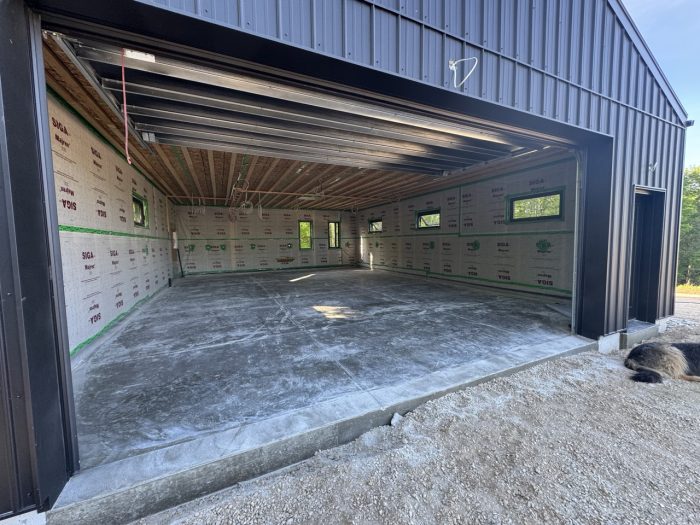
The building has 1.5” EPS on the exterior, R22 mineral wood in the 2×6 studs, and R60 blown cellulose in the attic. We also did proper air sealing on the OSB sheathing with Siga tape. Aside from the big garage door, it’s pretty well sealed and insulated.
The slab was only poured a few weeks ago but I measured the RH in there overnight and it was in the 60s, up to 67% RH. It was raining outside and I’m sure the slab is still curing.
Anyway it does not need to be a fancy space, I just thought the birch ply looks nicer than the other stuff. Our other option is using the select exterior plywood, cost is slightly lower but negligible overall, it looks adequate but is obviously rough and not as sleek as paint grade birch. I was not intending to finish the ply with anything. It would be nice to condition the space eventually, it’s just not happening in the near future.
Would you use the birch ply or stick with an exterior plywood product? Any other advice?
GBA Detail Library
A collection of one thousand construction details organized by climate and house part

Replies
The type of plywood makes little to no difference. Anytime the relative humidity is above 85-90%, the moisture content of unfinished wood or plywood will be high enough to support microbial growth. Adding a finish to the surface slows down that effect, so a short period of very high humidity becomes less risky.
Michael,
I've got two almost identical sheds and have experienced an interesting difference in how the plywood I used has fared.
My tool shed has construction grade plywood as both a ceiling and as roof sheathing, extending out to form the overhangs. My wife's she-shed has birch plywood instead. The overhangs on her shed accumulate white mold, where my tool shed doesn't - even though both are painted. Don't know if it is the absence of fungicides in the birch ply, the glues they use, or something else I haven't thought of?
Malcolm, it's hard to say. Maybe the sun hits the roof at different levels or air currents help one shed dry faster than the other. Your construction-grade plywood is probably fir, which has some natural anti-microbial components, whereas birch does not. Maybe it's that the birch veneer is super thin and likely uses continuous urea formaldehyde glue vs. the phenolic resin applied in stripes in the construction plywood. Maybe the smooth surface of the birch holds onto pollen and dust more tenaciously than what I imagine is a rougher texture for the construction grade plywood. Maybe you didn't use the same primer and paint on both.
A mold killing primer would probably be a good idea here. These are just special primers specifically made to prevent (or stop) mold growth. You'll lose that unfinished wood look, but have much less chance of mold problems this way.
Bill
Gah see I don’t want to paint the plywood, I want to see the wood! And clear coats would make it dark yellow, plus we would technically need to seal the edges of each sheet. That all sounds quite laborious. I have a horrible feeling I’m going to end up wanting to finish it with Osmo Polyx Raw, which will cost approximately $1 million.
It seems the only real answer to my problem is simply ensuring the humidity does not reach a high level. I wonder what is an acceptable RH for either plywood then? It’s high 60s now, but I’m assuming it’ll go up later in July I just don’t know by how much. It doesn’t go much higher than 50% in our home but we have an ERV running. I could put a dehumidifier in the garage, is that ridiculous? I’m not sure if the energy consumption would be absurd, running all summer only to open the 18ft door and let all the humid air in.
Malcolm, I’m envious of your sheds! Those look lovely.
Izzza,
My wife's is much nicer than mine. It has about 3000 books and a hammock.
Uh oh. Now I’m adding a “she-shed” full of books and a hammock to my very long wish list… pretty high up actually. Even better with a cat standing guard outside! 😁
Very few garages have mold problems. Mostly because most people don’t heat or cool them and they are generally pretty well ventilated. What this means is the garage walls almost never get cooler than the dew point of the air in the garage and do not accumulate enough moisture to support mold growth.
The curing concrete is an exothermal chemical reaction that generated heat that evaporated some of the water in the concrete with the doors closed and a cool night one might get some condensation. It would be a onetime event that would not concern me.
If you don’t heat the garage I doubt you will have a mold problem.
Walta
Interesting. I don’t think ours will be very well ventilated with all the air sealing but I suppose the large garage door is not perfectly sealed. I thought about your comment and it makes sense, it seems the bigger issue is going to be when we want to heat it then. We’re only planning to heat it minimally, eventually, but there will still be a big temp differential since we live in a cold climate.
What you care about with wood is moisture content, which has a complicated relationship with humidity and temperature. This post explains further: https://www.greenbuildingadvisor.com/question/wood-air-and-water-the-interplay-of-temperature-humidity-and-wood-moisture-content
Briefly, the warmer the temperature the less moisture wood can hold, it's hard to get dangerous moisture levels in wood above about 70F just from humidity. Moisture is more of a problem at lower temperatures, but at those temperatures air holds little moisture. So there's a good chance you can keep the moisture at a reasonable level just by ventilating during cold weather.
I said garages in general are well ventilated. Yours may or may not be well ventilated.
How you plan on heating the garage plays a big roll in if you are building a mold farm or not.
If the plan is to use an unvented fuel burning heater that almost 100% of the fuels volume gets turned into water vapor and dumps that moisture into the garage. Things are very likely to get moldy.
If the plan is a vented wood stove. That will pull tons of cold dry air in thru the gaps while expelling tons of warm moist air out the flue pipe. The humidity in the garage is likely to be under 15% and uncomfortably dry.
If the plan is to keep the garage just above freezing all winter long that sounds like a very risky game.
Walta