Zone 4A knee wall assembly question

JeffS1
| Posted in Energy Efficiency and Durability on
Assuming that my knee wall is very well air-sealed, will the following assembly still risk condensation in the heating season: 2×4 wood-framed knee wall, exterior sheathing is just foil-faced (both sides) polyiso foam board (no osb or plywood), R15 rockwool batts, 1/2″ drywall, latex paint. It seems like there’s a risk of condensation forming on the interior foil face of the polyiso board in the heating season, but this assembly is no different from the code required exterior wall assemblies for 4A except that there’s no exterior OSB or plywood sheathing. Thank you for any comments.
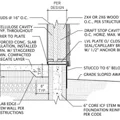
GBA Detail Library
A collection of one thousand construction details organized by climate and house part
Search and download construction details

Replies
Jeff,
The presence of sheathing doesn't really affect the assembly. What may is how much polyiso there is. If the R-value is too low then yes there is a risk of condensation on the inside face of the foam board. That risk is due to the foil facing. Unfaced polyiso is quite permeable. So the safe choices are:
- Adequately thick foil faced polyiso. https://www.greenbuildingadvisor.com/article/calculating-the-minimum-thickness-of-rigid-foam-sheathing
- Less thick unfaced polyiso, preferably with a class 2 vapour-retarder on the interior.
Thanks, Malcom. I see your points. This is a little difficult to figure out but the code says R10 continuous exterior with R13 interior works. But I can't find anything about faced sheathing, which will prevent drying to the exterior. The 1.5" of polyiso is a cost and labor effective way for me to get R10, but I can't find it unfaced. I can find XPS unfaced, of course, but then I need 2". XPS is a Class II vapor retarder so it would allow some to the exterior. But it seems like the interior surface of the XPS would be just as likely a condensation point as the foil-faced polyiso. Any further thoughts? Thank you.
Jeff,
The code is concerned with hitting minimum required R values for the wall. Looking at it solely from the perspective of risk, you only need R-2.5 continuous foam with a 2"x4" wall in climate zone 4 to be safe.
From the link I posted above:
Climate Zone, Minimum R-Value of Foam Sheathing
Marine Zone 4, R-2.5 for 2×4 walls; R-3.75 for 2×6 walls
Zone 5, R-5 for 2×4 walls; R-7.5 for 2×6 walls
Zone 6, R-7.5 for 2×4 walls; R-11.25 for 2×6 walls
Zones 7 and 8, R-10 for 2×4 walls; R-15 for 2×6 walls
So you can use 3/4" or thicker foil faced polyiso with no risk of condensation on the interior face, and painted drywall on the interior is fine.
As an aside: The reason you can use thinner permeable insulation, is that (much like exterior sheathing) even if the interior face is below the dew point, the moisture does not accumulate as long as the rate at which it hits the foam (or sheathing) is less than what can move thorough it and diffuse to the outside.
My opinion your assumption that your knee wall is well sealed is very likely wrong. Short of a blower door test less than 2 ACH50 I remain unconvinced.
Given older half story construction my opinion is rip out 100 % of the interior and filling the rafters from the ridge to the soffit with closed cell spray foam is your only hope for more than a marginal improvement.
Walta
Yeah, it's not well-sealed now but it will be after I seal it.