Design question for slab on grade

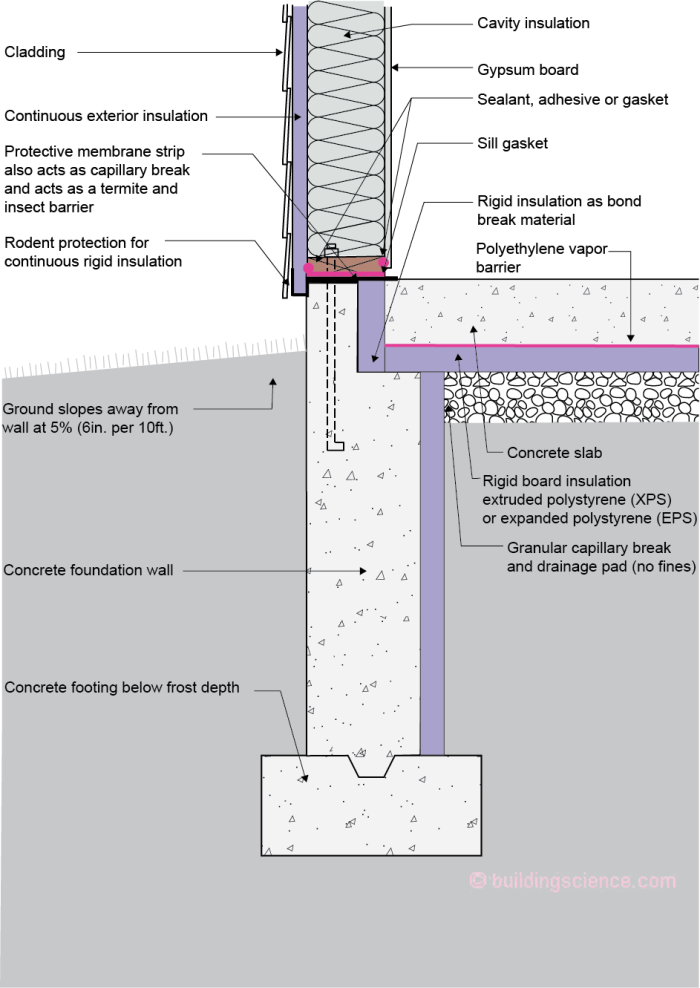
Suppose you have an insulated slab-on-grade foundation (example in attached image: Joe Latiburek, BSI-118, fig. 3), but you don’t want to live on a concrete floor (I don’t), can you build a wood floor with some ‘give’ on top of the slab?
I’m thinking of a couple possibilities:
1) Install 2×4 sleepers on the slab, theoretically at same height as the mudsill, attach subfloor, then build the walls on top of that. Would you do anything to seal the top of the slab, which already has poly, rigid, and crushed rock beneath?
2) Can you build a framed floor system (joists) attached to the mudsill, then sub-floor and walls? Again, would you seal the top of the slab? What about insulation? You already have rigid under the slab. Maybe just air seal and insulate the rim joists? The slab wouldn’t be doing much structurally, so maybe a thinner slab would be adequate. The slab would provide air-barrier continuity and help keep digging wildlife out of the floor system, good things both. I assume all utilities would be run under the slab, as if the wood over-floor wasn’t there.
Or would it be better to just insulate on top of the slab? Numerous examples, including some in BSI-118.
This would be for CZ 5B (Colorado front range).
Thank you,
Donald Christensen
GBA Detail Library
A collection of one thousand construction details organized by climate and house part

Replies
Don,
The workable variations people have successfully used are almost endless. Here are a few:
- Engineered wood flooring, or other modular material installed on an underlayment on the the slab.
- Two layers of subfloor floating over the slab.
- Same as above, but omit the slab between the subfloor and foam below (see c0nrete-free slabs).
- Sleepers and sub-floor over the slab.
- Framed floor over the slab.
As a general rule I would situate the insulation below the slab. Having it above to me only makes sense in a retrofit situation where there is none below.
If you have a good sub-slab vapour-barrier, and capillary break, there should be no need to seal the top of the slab.
Malcomb,
Thank you for your reply. It's good to know there are a range of valid choices. You have confirmed my conclusion that with good vapor control and capillary break under the slab, there is no need to seal the top (although I would plan to let the slab dry for a while). This would be new construction, so I agree, insulating under the slab is best.
Don,
My own preference would be for flooring that can go down with minimal underlayments between it and the slab. Both to keep the main floor level as close to grade as possible, and to avoid creating a cavity that serves no real purpose.