Double 2×4 wall detail – concerns over potential for moisture in the wall

I am located in western New York State (Climate Zone 6).
I am putting an addition onto an existing farmhouse and trying to use a wall section that is simple, easily buildable and breathable. My thought is to stick with more conventional building materials rather than try to use ZIP system or ZIP-R panels. I am planning to do a lot of the work myself after the framing is completed.
I am proposing vinyl siding, Tyvek Homewrap (taped), 7/16″ OSB sheathing, exterior 2×4 stud wall with R-15 rockwool , interior 2×4 stud wall with R-15 rockwool, and Drywall, painted. the wall will be basically 8 inches thick and i would like to use a 2×8 for my sill plate and a 2×8 for my top second top plate to unify the two 2×4 walls.
My question is where to put the air barrier/vapor retarder AND would a smart vapor barrier be advisable. I would prefer to put it in between the two 2×4 walls because that will be easy to install and will have minimal penetrations in it. That would allow me to treat the interior 2×4 wall as a service cavity for electrical wiring and boxes.
I think my wall section will be pretty breathable and should dry well, but I am concerned that the vapor retarder will accumulate moisture since I think the temp will be in the range where condensation may occur during the heating season. I realize my wall sheathing is proposed to be on the outside and i am not proposing to have any continuous insulation, however, I refer to the guidance concerning continuous insulation and determining the approximate location for the dew point.
The Mean temperature for Dec, Jan, and Feb at my location is 25 degrees F.
Is it reasonable to calculate that the middle of the wall should still be above the dew point and therefore moisture is unlikely to accumulate on the vapor retarder? Am I missing something?
Finally, I realize this is only an addition on an existing house that is probably fairly leaky. I’m just trying to to the best i can with the addition
GBA Detail Library
A collection of one thousand construction details organized by climate and house part
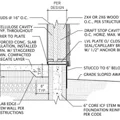

Replies
cdhennin,
The rough rule of thumb to avoid condensation in walls is that only 25% to 30% of the R-value of the wall should be inside the vapour-barrier. So if you want t0 have it between the two walls, you should model it to make sure it will work.
A variable-perm vapour-retarder is primarily useful if the house is going to be air-conditioned for a prolonged period of the year, when an impermeable vapour-barrier would be on the wrong (cold) side.
Malcolm, I do have a question about why the Lstibureks ideal double stud wall design has the OSB layer in the middle (see https://www.greenbuildingadvisor.com/article/lstibureks-ideal-double-stud-wall-design).
This article says the OSB in the middle of the wall serves as the primary air control layer as well as the vapour barrier. It seems that if OSB is recommended in this wall, it wouldn't be a problem to do it in my proposed wall. I'm not trying to be difficult, but i'm just trying to continue the conversation and understand the risks associated with various solutions.
IN FACT, i'm questioning why i don't just use OSB as in the detail??? OSB is currently about $0.33 per SF and Siga Majrex 200 is closer to $0.55 per SF.
cdhennin,
The ratios only come into effect when the moist interior air moving though the wall hits impermeable material like a vapour-barrier. As long as that surface is vapor-open, and the amount of moisture moving though the wall is less than that material can pass through it by diffusion, then no damage occurs.
The warmer that central layer is the safer it is. You can see from the section in the link you provided that there is more insulation on the exterior of the OSB than inside it, and Martin makes reference to the rule of thumb I mentioned in his first comment below the article.
Here is the point I hope others weigh in with some clarification: I still see the advice that variable-perm (smart) vapour-retarders be located close to the interior face of walls. Does their ability to open up remove the risk and they can be moved further out?
I'm going to post that as a separate question in the Q&A
Deleted
cdhennin
There has been some good discussion in this thread: https://www.greenbuildingadvisor.com/question/variable-perm-smart-vapour-retarders?cid=301724&discussion=response#comment-301724