For a frost protected shallow foundation how do I compact gravel?

I’m looking at a frost protected shallow foundation for a zone 6a garage. Code calls for a 12″ thickened edge for the “footing”, and then I intend to use a 5″ slab for the center. The guides require 6″ of free draining gravel (#57 is often suggested), at the bottom of the thickened edge and also in the field.
All the guides I’ve found specify free draining gravel, this include the Revised Builders Guide to Frost Protected Shallow Foundations as well as ASCE 32-01. They also specify that it must be compacted, but everywhere I look, it says that free draining gravel doesn’t really compact because of the lack of fines.
So, how do I compact the gravel under the insulation as the guides say?
Do I need gravel on the slope from the bottom of the thickened edge to the center of just in the center?
If it’s just in the center, how do I keep the gravel in the center from sliding down the slope? I saw a suggestion of geogrid to contain the drainage gravel, but that source seemed suspicious.
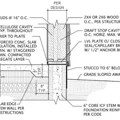
GBA Detail Library
A collection of one thousand construction details organized by climate and house part

Replies
Both #57 and #5 gravel should suit your purposes. You want to make sure it is crushed, i.e. have angular edges, and isn't rounded like river rock. Then angular edges will interlock as it is being compacted, giving you a mass that still drains freely but doesn't move around.
I don't have a lot of personal experience actually installing the material. But the article I'm linking to provides very thorough directions. Hopefully this will help.
https://www.dirtconnections.com/how-to-properly-install-57-stone-aggregate-for-long-lasting-performance/
With a 12" deep footing and a 5" slab you'll have a vertical difference of 7" from the underside of the footing to the underside of the slab. You should be able to get the compacted gravel to hold a slope of about 1:2. So you should be able to slope it up 7" by extending inward 14". It's not critical that it be a very even slope. You just want to make sure to have a full width footing, good and flat. The sloped section can very a bit.
aberman,
Clear crushed stone doesn't compact but it does benefit in two ways from having a compactor run over it.
- While it doesn't compact, it does consolidate, much as a jar of walnuts will if you gently tap it.
- A compactor forces the bottom layer of stone into the substrate below until it reaches refusal, so you don't get this occurring later and the stone subsiding under the slab.
It's a good question because the terminology around “free-draining gravel” and “compaction” is confusing. The short answer is: you are not trying to compact #57 stone the same way you would compact a soil or dense-graded aggregate. You are trying to seat and stabilize the stone, not densify it. https://www.genesiscard.com.co
Thank everyone, this is really helpful.
As Antonio described above, I'll have a 14" long slope at 1:2 grade to compact. What do I use to compact that? A plate compactor seems like it would be unstable on the slope.
aberman,
Discussion about the function of the sloped transition comes up repeatedly on structural engineering forums, and I've never seen a particularly convincing explanation for why it is better than connecting the slab to the thickened footing with a vertical face.
If someone can direct me to a useful discussion on the subject I'd be grateful.
I can suggest something in "theoretical" terms.
In the case of a slab with a footing rigidly rectangular, the vertical inner face of the footing can act as a sort of anchor or restraint around the perimeter of the slab. This would increase the likelihood and width of cracks forming in the slab as it cures and shrinks. There would also be the possibility of a stress concentration happening where the footing inner edge aligns with the thinner slab. This could cause that very unsightly spot to crack more.
A slab with a footing whose inner face is sloped could conceivably "ride" the slope as shrinkage occurs, reducing cracking. It also wouldn't have the stress concentration issue.
All that said, it's beside the point if the concrete mix is properly designed and the slab is properly placed, cured, and has appropriate control joints.
And no, I can't support any of the above with rigorous data collected from real world tests. But I figure it doesn't hurt to give it a moment's thought, then move on to life's bigger problems.
Antonio,
"But I figure it doesn't hurt to give it a moment's thought, then move on to life's bigger problems."
That's pretty much where I ended up after looking at the issue a few times.