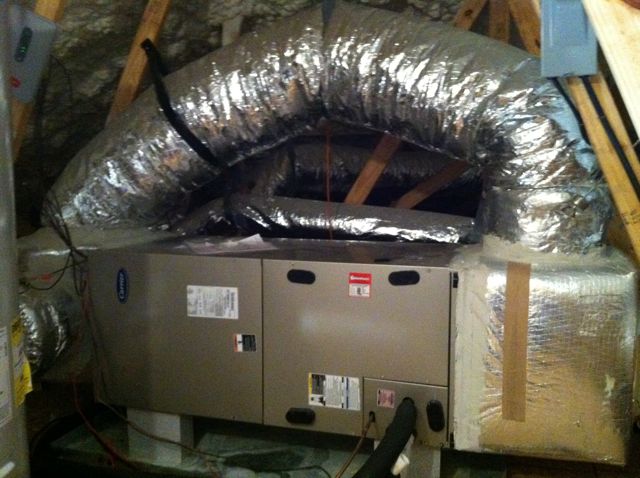
A Florida homeowner called an HVAC company because her air conditioner kept shutting off. The technician climbed into the attic and found the drain pan beneath the air handler full of water, enough to trip the float switch that cuts power to the AC. His explanation was that this is just how things go in Florida, and that the pan needs emptying every couple of months. That's a hard sell. A pan that fills high enough to kill the cooling isn't routine maintenance. It's a symptom.
Where the water in the pan comes from
An air conditioner's evaporator coil does two things. It cools the air passing over it, and it pulls water vapor out of that air, which is the latent cooling job we call dehumidification. In a hot, humid market like Florida, that second job matters as much as the first.
Here's the thing many owners don't realize: an air conditioner has two drain pans. The primary pan sits inside the air handler, directly under the coil. The secondary pan is the one you see beneath the unit. Condensate normally leaves through a drain line, but when that line clogs, the primary pan fills and spills into the secondary.
In Florida, that clog is usually bacterial biofilm. The slime can grow until it fills the pipe, and technicians sometimes pull out long cylindrical plugs of it. A clogged line is the most common reason a pan overflows, and it deserves attention on its own.
But the problem I want to focus on is a different source of water. Technicians across Florida are reporting it, and it's likely showing up in other hot, humid climates too. This time, nothing is clogged. The water is condensing on the outside of the air handler and dripping into the pan. Let's look at why that happens and what you can do about it.
How the outside of a cabinet starts to sweat
The physics is simple. When humid air touches a surface that's cold enough, water vapor molecules start sticking to it instead of bouncing away. Once enough of them stick, you see beads of water forming on the surface, like the droplets in the photo above.
The threshold is the dew point temperature. Any surface sitting below the dew point of the surrounding air will collect condensation. On a sticky Florida day, the dew point can reach 77°F (25°C). A typical air conditioner supplies air at roughly 55°F (13°C), and that's the air moving through the ductwork and the air handler.
So the question becomes whether the outside of an attic air handler can stay above 77°F while 55°F air runs through it. Usually, yes. Whether it stays above that line depends on the attic and the system, and that's where things get interesting.
Why most attic air handlers stay dry
Manufacturers insulate their air handlers, and that insulation does most of the work of keeping the cabinet above the dew point. The attic itself helps too, and in a way that surprises people.
A standard vented attic can reach 130°F (54°C) or so on a hot afternoon. That heat warms every surface exposed to it. Heat also radiates down from the underside of the roof deck, so anything that can see the roof picks up warmth. The combination keeps most air handlers warm enough to resist sweating in humid weather.
You might still spot some condensation now and then, usually at thermal bridges or places where cold air leaks out of the cabinet. That's typically not enough water to trip the float switch. The trouble starts when something pushes the surface temperature down past the dew point and keeps it there.
Two conditions that push the unit over the edge
Remember that condensation forms when a surface drops below the dew point. Two situations can make that happen in an attic, and both are more common than you might think.
1. A cooler attic. Vented attics get very hot, which is why they help keep air handlers warm. But more builders are now installing radiant barriers to cut energy use, and those lower attic temperatures. The lower air temperature does cool the air handler, but my read is that the bigger effect comes from reduced radiant heat flowing from the roof deck directly onto the cabinet. Take away that radiant load, and the unit loses one of its main sources of warmth.
2. Colder conditioned air. Most systems deliver air around 55°F, but a few things can push that number lower. A restrictive duct system is one. Less airflow means the coil runs colder, and the air leaving it is colder too. Low airflow can come from undersized or leaky ducts, a clogged filter, or a combination of problems that nobody has traced.
A second way to get colder air is a fixed-capacity system with two or more zones and a bypass duct. When some zones are satisfied and others aren't, the excess air gets dumped into the bypass and routed back to the return side. That already-cold air mixes with the return air, so the coil sees even colder air, and the supply comes out colder still. In bad cases, the coil freezes into a solid block of ice.
Put those two conditions together, a radiant-barrier attic and a zoned system with a bypass duct, and you've built the setup most likely to sweat. If you want to keep condensation off the air handler, that's the combination to avoid.
Fixes, from easy to expensive
Some of these solutions cost an afternoon. Others cost a renovation budget. Here's how I'd sort them.
Replace dirty filters. A clogged filter by itself can cut airflow dramatically. I've seen cases where it led to a frozen coil, so this is the first thing to check and the cheapest fix available.
Adjust the refrigerant charge if necessary. A system low on refrigerant lets the coil and the suction line, the insulated copper pipe, run colder. That probably isn't enough on its own to trip the float switch, but it can add to the problem.
Fix the duct system. If airflow is low, the next question is why. Duct systems go wrong in many ways, so bring in someone who understands airflow and can measure it rather than guess.
Eliminate the bypass duct. I'm not a fan of bypass ducts. Most well-designed zoned systems control zones with equipment rather than dampers and bypass paths. The zoning best practices I've written about cover the details.
Encapsulate the attic. Moving the insulation and air barrier to the roofline brings the attic inside the thermal enclosure. That removes the cold-attic problem, but you still need to condition the air to control humidity, because a sealed attic can hold moisture if nothing manages it.
Move the air handler into conditioned space. Even if the ducts stay in a vented attic, getting the air handler itself into conditioned space can make a big difference. It's one of the more expensive fixes, and one of the most effective.
The sequence matters. Start with the inexpensive airflow checks, then look at the duct system and the zoning design. Attic envelope changes and relocating equipment come after you've confirmed the cheaper steps aren't enough.
And no matter which fix you choose, emptying the drain pan should never become a regular maintenance task. A pan that keeps filling is a diagnostic clue. If a contractor tells you otherwise, that's a good reason to get a second opinion from someone who will look at the airflow and the attic conditions before reaching for a bucket.