Where the warning comes from
Mount cabinets on an exterior wall and someone will eventually warn you about mold growing behind them. The warning sounds plausible, and a homeowner in the middle of a mudroom build has every reason to take it seriously. The people who work on this stuff daily see the risk as real in some wall assemblies and mostly irrelevant in others.
Part of the warning's staying power is that it's easy to repeat and hard to disprove on the spot. Mold is a visible, unpleasant outcome, and nobody wants to be the person who skipped a step that later turned into a damaged wall. That fear isn't wrong, but it's aimed at the wrong variable. The question worth asking is what the wall is doing, not just what is attached to it.
Why the blanket warning misses
Impermeable finishes on exterior walls are everywhere. Mirrors, tile, bathtubs, and showers all sit on exterior walls in nearly every house in North America, and nobody's tearing those out over condensation. The question that matters is which direction the wall is designed to dry. In heating-dominated climates, vapor drive pushes moisture from warm inside toward cold outside. A wall built to dry outward doesn't care much whether a cabinet sits against it.
Here's the thing: a wall is a system, not a single material. Moisture moves through it by vapor diffusion, air leakage, and bulk water, and each path behaves differently depending on what's layered into the assembly. A mirror or tile on the face changes how easily vapor escapes to the interior, but it won't trap moisture by itself unless the rest of the wall is also shut in. Similar systems typically rely on the outward drying path to keep things in balance, which is why the finish alone rarely decides the outcome.
Where the R-value math actually bites
Cabinets become a problem through thermal performance, not finishes. A cabinet back runs around R-4. If the wall behind it is also around R-4, the drywall surface lands about halfway between indoor and outdoor temperatures. That cold spot is where condensation and mold can start. It's a known headache in tiny houses on wheels with steel framing, where thermal bridging is hard to avoid and the framing itself conducts cold straight to the interior surface.
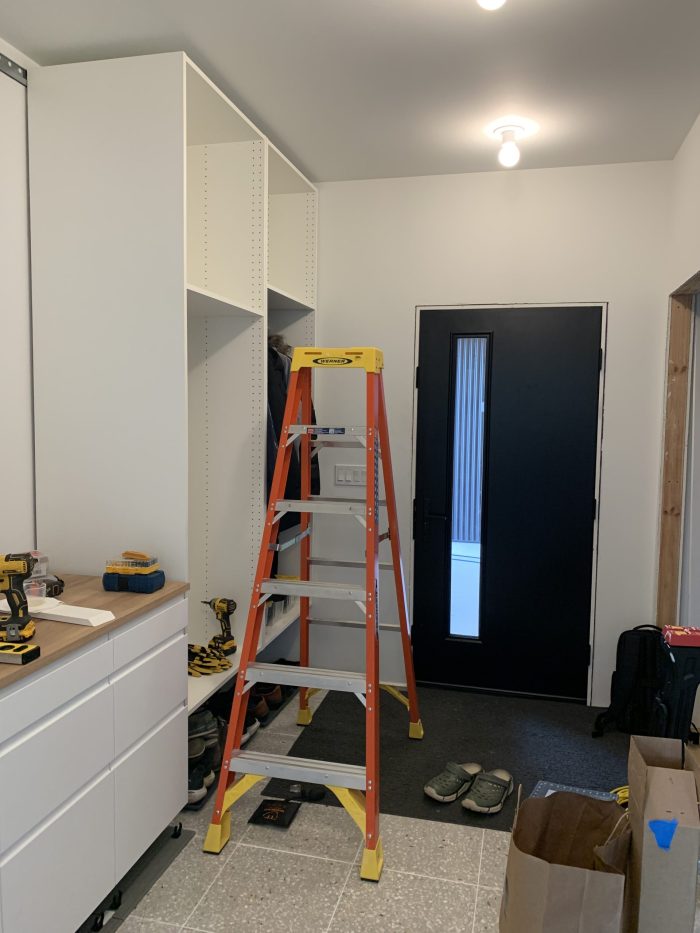
Newer construction with walls in the R-18 to R-24 range is a different story. The drywall there sits only a couple of degrees below room temperature, so the cabinet barely registers. (And this is the part most people overlook: the surface temperature is what matters, not the air temperature of the room.) The wall described here, 2x8 framing with Rockwool, falls into the higher-performing group, which is why the experienced replies came back so relaxed. I think this is more significant than it looks, because it means the cabinet question is really an insulation question wearing a different outfit.
Keep the backing or close it up?
The homeowner's real dilemma is whether to strip the particleboard backing so air can move, or seal everything behind trim and filler strips. Neither responder saw a reason to strip it. The small gap and the openings at the top and bottom won't change the outcome in a wall like this one. A trimmed-out built-in look is a reasonable call.
I'd argue the backing debate gets more airtime than it deserves. Air movement behind a cabinet sounds like it should matter, and in theory it does. In practice, the amount of air moving through a narrow gap in a well-insulated wall is small enough that it rarely decides anything on its own. Air movement. Almost nothing in practice. If you're deciding between a clean finished look and a fussier open-back design, the finished look is the defensible choice for this wall, provided the insulation is what it appears to be.
Where to put the effort instead
If you want the mudroom to work harder, spend the time on heat and air. Floor heating under the tile, such as a resistance mat, dries wet boots fast and makes the room far more pleasant to walk into. People tend to underestimate how much a warm floor changes the way a space gets used, and in a mudroom that's most of the point. It also keeps the area from becoming a cold, damp pocket in winter, which matters more than whether the cabinets are finished on the back.
If the house has an ERV, a stale-air pickup in the shoe closet does more for odor than almost anything else you can add. Shoes, damp coats, and gym bags generate moisture and smell, and a closet with no air exchange just holds onto both. That said, a pickup needs to be sized and balanced with the rest of the ventilation, so it's worth asking whoever designed the system before you cut the hole. Ventilation fixes like this are cheap compared with rebuilding a finish that's gone sour.
Before you finish the cabinets, though, confirm the insulation level in that wall. That single number decides whether the cabinets are a non-issue or a genuine problem. Check the plans, ask the builder, or look at the wall during construction if you still can. Guessing from the framing size alone won't tell you what's actually in there.
What this means for your build
If you're working in this space, the useful question isn't whether cabinets are allowed on exterior walls. It's whether the wall has enough thermal resistance to keep the back surface comfortably warm. Ask for the assembly details, confirm the R-value of the insulation, and think about the drying direction before you finish anything. Those three checks will tell you more than any blanket rule.
What this means for you, in practice, is that the warning isn't wrong so much as incomplete. The mold risk is real in certain wall types, especially lightly insulated ones with cold framing. It's largely absent in better-built walls, and treating every exterior wall the same way wastes effort on the wrong problem. Expect the advice to keep shifting toward checking the numbers first as wall assemblies continue to tighten, because the underlying physics isn't going to change. The cabinets will probably be fine. Just confirm that first.