First-time buyers need a budget they can live with, not just a better mortgage rate
Mortgage rates dominate the headlines, but they’re only one part of the first-time buyer calculation. The more useful question is whether the monthly payment leaves room for the rest of life. That’s a harder measure than a headline rate or a lender’s maximum borrowing figure, and it’s where many buyers feel least certain.
Economic uncertainty, global conflicts, higher borrowing costs and the challenge of saving a deposit are weighing on would-be buyers. Still, wage growth, changes to lenders’ affordability assessments and possible government support could improve the options some people have. Matt Smith, Rightmove’s Mortgage Expert, argues that buyers should look closely at what they can sustain, rather than waiting for mortgage rates alone to make the decision for them.
Why buyers feel unable to move
For many first-time buyers, mortgage approval isn’t the only hurdle. They want to know that repayments will fit alongside bills, savings and other commitments. Rightmove’s survey found that 52% worry about the monthly cost of a mortgage. Many aren’t trying to borrow as much as possible; they’re looking for a payment that works with their budget and lifestyle.
“For many first-time buyers, the biggest question isn’t how much they can borrow. It’s whether the monthly payment feels manageable alongside everything else in their lives,” says Smith.
That calculation can be difficult to pin down. Buyers may hear that a lender could offer up to 4.5 times their salary, but lenders assess more than an income multiple. Spending, existing debts and disposable income all shape the amount a person may be able to borrow. The result can feel opaque: buyers are left unsure what their income will actually support.
Rate headlines can encourage people to wait
Market coverage adds to that uncertainty. In Rightmove’s survey, 44% of first-time buyers said they were concerned about mortgage rate changes, and some are putting off decisions while they wait for conditions to settle.
“Mortgage rate rises often attract significant media attention, while frequent reporting on economic changes can create a feeling that waiting may be the safer option,” Smith says. “Whilst these factors will always be outside our control, there are tools available to help prospective buyers know what they can comfortably afford in the current market.”
Here’s the thing: waiting may feel like a decision, but it doesn’t guarantee that rates or prices will move in a buyer’s favour. A clearer view of personal affordability gives buyers something more concrete to work with.
Some signs point to improving affordability
The barriers remain real, but conditions aren’t standing still. Earnings are currently growing faster than house prices, which may gradually strengthen some buyers’ budgets. Rightmove’s House Price Index reports that asking price growth for typical first homes has stalled in recent years.
In September, the average asking price for a first-time buyer home was £225,199. Average borrowing was £176,904 for a single buyer and £353,808 for joint buyers. Those figures give a useful snapshot, but they don’t establish what any individual household can afford.
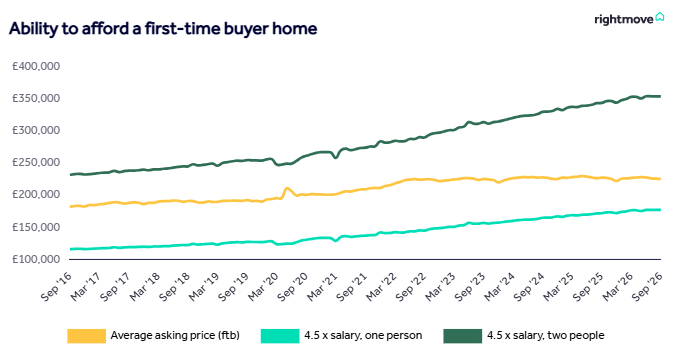
For people who have been saving, rising earnings may create a little more room in the budget and bring a purchase closer. It won’t erase the pressure quickly, though. The improvement depends on how wages, prices and a buyer’s own finances change over time.
Lenders are looking at more than salary multiples
Regulatory and assessment changes have given lenders more flexibility in how they review applications. That may open up possibilities for some borrowers, but the effect will differ by lender and applicant. Affordability checks still apply, and a change in approach doesn’t guarantee approval.
In practice, a lender’s view can depend on spending habits, financial commitments and disposable income as well as salary. That broader assessment may help some buyers whose circumstances don’t fit neatly into a simple income multiple. It also means there’s no single rule that tells every buyer what they can borrow.
Possible schemes could ease the deposit hurdle
Buyers can also review available first-time buyer schemes. One proposed option, the Your First Home scheme, could reduce the upfront deposit for eligible purchasers.
The Government says eligible buyers are expected to be able to buy a participating new-build home in England with a 2.5% deposit, alongside a government-backed equity loan of 20% with an initial interest-free period. The qualifying rules and longer-term cost of that loan have yet to be confirmed, so buyers don’t yet have the full details needed to assess the offer.
Make the budget the starting point
Look at the whole mortgage offer
The interest rate matters because it affects the cost of borrowing. But buying power also depends on lending criteria, household income, deposit size and which mortgage products are available. As criteria change, the options in front of a buyer may shift too. A rate headline alone won’t tell you what you can borrow or whether a payment is sustainable.
Work out what you can pay each month
Start with the monthly figure that leaves enough for ordinary expenses, future savings and unexpected costs. The property price matters, but so does the life that continues after the purchase. A payment that fits today may feel different if circumstances change, so leave room for that possibility.
For many buyers, this gives a more practical measure than focusing on the largest loan a lender might offer. Rightmove’s Mortgage Calculator can help estimate repayments; a Mortgage in Principle can help buyers see what they may be able to borrow.

Keep an eye on lender changes
Lending rules and products can shift as lenders respond to regulation and market conditions. Some people who didn’t qualify for a particular product before may find new options appear, but that isn’t assured. Eligibility and affordability still depend on the lender’s criteria and each applicant’s circumstances. Following changes can help buyers understand the choices available when they’re ready.
Plan around uncertainty
Inflation and global events can affect confidence, mortgage products and housing demand, and predicting their effects on affordability is difficult. Among survey respondents delaying a purchase, 57% were hoping for lower property prices and 37% were waiting for lower mortgage rates.
Those hopes may be realised for some buyers, but waiting carries uncertainty too: prices, rates and personal circumstances can move in different directions. Buying a home is a major financial decision, so wanting a clearer picture is understandable. Yet certainty may not arrive on a convenient timetable.
“It’s still worth following what is going on with house prices, interest rates and what support there is for first-time buyers. But rather than focusing on factors that are difficult to control, buyers should focus on the things they can influence themselves,” Smith says. “Buyers who understand their budget and keep informed about available options are often in a stronger position to act when the right opportunity comes along.”
Building savings, strengthening a credit profile and getting a clear view of affordability can all help buyers prepare. The practical test remains whether the purchase works for their finances and their lives.